How to Fix a Squeaky Door Without Tools
There are few things in daily life more quietly annoying than a squeaky door. It wakes people up when you are trying to be quiet. It draws attention to every entry and exit. It makes an otherwise well-maintained home sound neglected. And every time it happens you think “I really need to fix that” and then forget about it until the next squeak reminds you again.
The good news is that fixing a squeaky door almost never requires a trip to the hardware store, a toolbox, or any technical skill whatsoever. Most squeaky doors can be fixed in under ten minutes using things you already have in your home right now. No screwdrivers. No hammers. No WD-40. No experience required.
This guide covers every no-tool method for silencing a squeaky door that actually works, why doors squeak in the first place so you can address the real cause rather than just treating the symptom, and what to do if the simple fixes do not solve the problem completely.
Why Doors Squeak in the First Place
Before reaching for the petroleum jelly or the bar of soap it helps to understand what is actually causing the squeak because different causes respond to different solutions. A squeak that comes from the hinges needs a different approach than a squeak that comes from the door rubbing against the frame. Knowing which you are dealing with saves you from trying multiple fixes that do not address the actual problem.

Dry or Dirty Hinges
This is by far the most common cause of a squeaky door and the good news is that it is also the easiest to fix. Door hinges are metal moving against metal. When the hinge pin and the hinge barrel are dry, meaning there is no lubrication between the moving surfaces, the metal-on-metal contact produces the characteristic squeaking sound every time the door moves.
Over time hinges lose whatever factory lubrication they had, accumulate dust and grime, and sometimes develop a thin layer of surface rust. Any of these conditions increases friction and noise. The solution is simple lubrication and it can be achieved with a wide range of household products.
Door Rubbing Against the Frame
The second most common cause of a squeaky or noisy door is the door itself rubbing against the frame as it opens or closes. This can produce a squeak, a scrape, or a grinding sound depending on how severe the contact is and what materials are involved. It is often caused by the house settling slightly over time which shifts the door frame out of perfect alignment, by humidity changes that cause the door to swell in wet weather, or by loose hinges that allow the door to sag and contact the frame.
Loose Hinge Screws
If the hinge screws have worked loose over time the door will move slightly in ways it should not and the resulting friction between various surfaces can produce squeaking. Loose hinge screws are a slightly more involved fix since they technically require a screwdriver but even this can sometimes be addressed temporarily with household items while you wait for a more permanent solution.
Paint or Grime Buildup
In older homes layers of paint applied over the years can build up on door hinges to the point where the hinge cannot move freely. The paint acts as a rough, rigid coating on what should be a smooth, freely moving surface and the result is noise every time the door moves.
The Household Lubricants That Actually Work
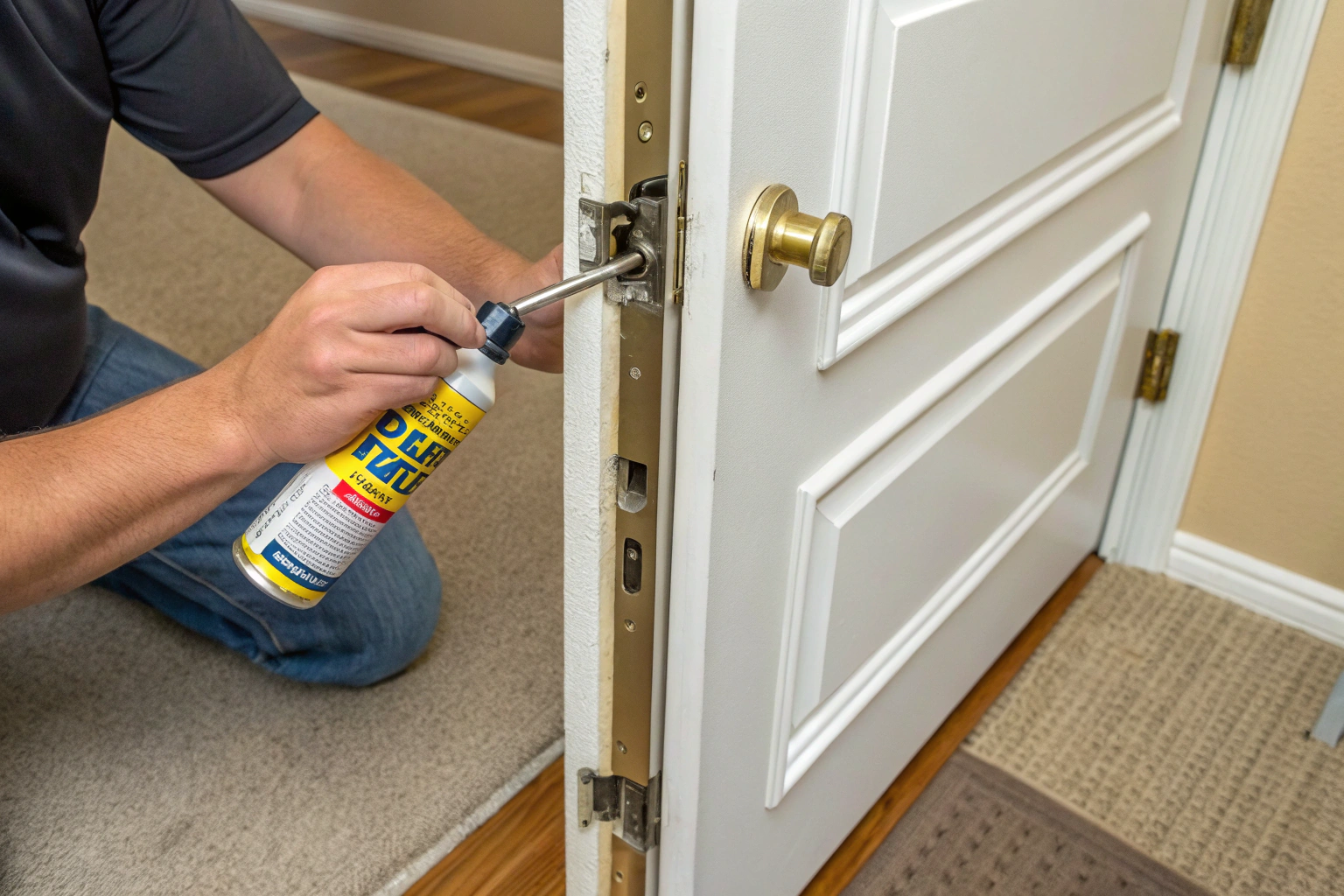
The no-tool fix for a squeaky hinge works by introducing a lubricant between the hinge pin and the hinge barrel so that the metal moves smoothly rather than grinding. The following are all effective lubricants that most people have at home right now.
Petroleum Jelly or Vaseline
Petroleum jelly is one of the most effective lubricants for squeaky hinges and almost every household has a jar of it somewhere. It has a thick, paste-like consistency that stays on the hinge rather than dripping off, it does not attract dust the way some thinner lubricants do, and it is completely safe on all metal surfaces.
To apply it without tools, open the door fully and apply a small amount of petroleum jelly to the hinge pin and around the opening of the hinge barrel using your finger. Work the door back and forth several times to distribute the lubricant into the hinge. If the squeak persists apply a little more and repeat. For most squeaky hinges caused by dryness this is the only fix you need and it will last for months.
Bar Soap or Candle Wax
A plain bar of soap or a white wax candle is a surprisingly effective hinge lubricant and has been used for exactly this purpose for generations. The waxy surface of both materials reduces friction between metal surfaces effectively and without leaving any residue that could stain paint or carpet.
Rub the bar of soap or candle directly along the hinge pin and into the gap between the hinge leaves where the pin sits. Work the door back and forth to distribute the wax into the mechanism. The squeak typically disappears immediately or after a few cycles of the door.
Soap and wax are particularly good options if you are concerned about petroleum-based products near painted surfaces or fabrics since they are completely inert and leave no stain.
Olive Oil or Cooking Oil
Cooking oil is the most universally available lubricant in any home and it works well for squeaky hinges as a short-term solution. Dip a cotton bud, a piece of kitchen paper, or your finger in a small amount of olive oil or vegetable oil and apply it to the hinge pin and barrel.
The limitation of cooking oils as hinge lubricants is that they are thinner than petroleum jelly and will drip more easily which can potentially stain carpet or flooring beneath the door. Apply sparingly, place a sheet of kitchen paper under the door to catch any drips, and wipe away any excess after working the door back and forth.
Cooking oil is also more likely to attract dust and grime over time than petroleum jelly or wax which means the fix may not last as long. It is an excellent emergency solution but petroleum jelly or wax will serve you better for longer.
Coconut Oil
Solid coconut oil, the type that is solid at room temperature, behaves very similarly to petroleum jelly as a hinge lubricant. It has a thick consistency that stays in place, it spreads easily with a finger, and it is an effective lubricant for metal-on-metal friction.
Apply it the same way as petroleum jelly, directly to the hinge pin and barrel with your finger, and work the door to distribute it. The slightly lower melting point of coconut oil compared to petroleum jelly means it may become slightly more fluid in warm weather but this is unlikely to cause any practical problem in most home environments.
Hair Conditioner or Hand Lotion
Most hair conditioners and hand lotions contain silicone compounds or oils that provide genuine lubrication. They are thinner than petroleum jelly and therefore not the ideal long-term solution but as an immediate fix for a squeaky hinge they can be surprisingly effective.
Apply a small amount to the hinge using your finger, work the door back and forth, and wipe away any excess from visible surfaces. The squeak will often disappear immediately and the fix will last for several weeks in most cases.
Butter or Margarine
Yes, ordinary kitchen butter or margarine works as a hinge lubricant. It is not the most elegant solution and it is not one that will last particularly long or hold up in warm conditions but it absolutely reduces hinge friction and eliminates squeaking in the short term.
The concern with butter is that it can go rancid over time and potentially produce an unpleasant smell. It can also attract insects in warm climates. For a permanent fix use petroleum jelly or wax. For an immediate solution when nothing else is available, butter works.
How to Fix a Door Rubbing Against the Frame Without Tools
If the squeak or scrape is coming from the door rubbing against the frame rather than from the hinges, lubrication will not solve the problem completely because the issue is physical contact between the door and the frame rather than dry friction within the hinge mechanism. Here is how to address rubbing without tools.


Identify Where the Door Is Rubbing
Open and close the door slowly and listen carefully to identify exactly where the sound is coming from. Look for scuff marks or paint wear on the door edge or the frame which will tell you exactly where contact is occurring. Common rubbing points are the top corner of the door opposite the hinges, the bottom edge of the door, and along the latch side of the door.
Use a Bar of Soap as a Dry Lubricant on the Rubbing Point
Once you have identified the rubbing point, rub a bar of soap directly onto that edge of the door. The soap acts as a dry lubricant that reduces the friction between the door and the frame enough to eliminate the noise. This is a temporary solution since the soap will eventually wear away with use but it works well as an immediate fix.
Use a Sheet of Sandpaper Folded in Half
If you have sandpaper available, even a single sheet, you can remove a small amount of material from the rubbing point by folding the sandpaper and working it back and forth against the door edge in the area of contact. This is not strictly a no-tools approach but it does not require any powered tools or special equipment and a single sheet of sandpaper costs almost nothing.
Removing even a fraction of a millimeter of material from the rubbing point is often enough to eliminate the contact that is causing the noise. Work gradually and test the door frequently to avoid removing more material than necessary.
Check the Hinge Screws
A door that rubs against the frame on the latch side is often doing so because the hinges have sagged slightly as hinge screws have worked loose. If you can tighten the hinge screws with a coin, a butter knife, or any flat object that fits the screw head you may find that the door returns to its correct position and stops rubbing. This is the most permanent solution for rubbing caused by sagging and is worth attempting before any other approach.
Step-by-Step: Fixing a Squeaky Hinge Without Tools
Here is the complete process for fixing the most common type of squeaky door, dry or dirty hinges, using only items from your home.
First identify which hinge or hinges are squeaking. Open the door fully and hold it still. With someone else’s help or by propping the door open, slowly move it back and forth by hand a small amount and listen carefully to identify which hinge the sound is coming from. In most cases it will be the middle hinge on a three-hinge door since this bears the most weight.
Next choose your lubricant from the options above. Petroleum jelly is the best overall choice if you have it. Soap or candle wax is the best alternative if you do not.
Apply the lubricant to the outside of the hinge. You do not need to remove the hinge pin to lubricate a hinge effectively in most cases. Work the lubricant into the gap between the hinge pin and barrel, around the top and bottom of the barrel where the pin enters and exits, and into any visible gap between the two hinge leaves. Use your finger for petroleum jelly, coconut oil, butter, or lotion. Rub the bar of soap or candle directly against the hinge surfaces for those options.
Move the door back and forth repeatedly, ten to twenty times, to work the lubricant into the mechanism. Listen for whether the squeak has disappeared, reduced, or is unchanged.
If the squeak has disappeared you are done. Wipe away any excess lubricant from the door and frame with a damp cloth so it does not attract dust.
If the squeak has reduced but not disappeared apply more lubricant and repeat the process. Persistent squeaks sometimes require two or three applications to fully distribute the lubricant into all the surfaces of the hinge where friction is occurring.
If the squeak has not changed at all despite lubrication the cause is likely rubbing rather than hinge friction and you should move to the frame-rubbing solutions described above.
When the No-Tool Fixes Do Not Fully Work
Most squeaky doors respond completely to lubrication applied without any tools. But some situations require a slightly more involved approach.


Paint-Covered Hinges
If your hinges are covered in layers of old paint they may need the paint removed before lubrication can be effective. You can remove paint from hinges without tools by applying nail polish remover or a paint stripper to the hinge surface and wiping it away with a cloth or cotton pad. Once the paint layer is removed, apply your chosen lubricant and the squeak should disappear.
Rust on Hinges
Light surface rust on hinges can sometimes be addressed without tools by applying a small amount of white vinegar to the rusted surface and leaving it for ten to fifteen minutes before wiping clean. The mild acid in the vinegar dissolves light rust effectively. Follow with a petroleum jelly application to lubricate and protect the cleaned surface.
For heavier rust a screwdriver to remove the hinge and proper rust treatment will produce better results but light surface rust responds well to the vinegar method.
Door That Has Swollen Due to Humidity
A door that squeaks or sticks in wet weather due to humidity-induced swelling will continue to cause problems until the humidity changes or the door is planed to create more clearance. The soap rubbing method will provide temporary relief but the longer-term solution involves either waiting for the humidity to reduce, improving ventilation in the room to reduce ambient moisture, or having the door edge planed by a joiner to create permanent clearance.
Preventing Future Squeaks
Once you have fixed the squeak it is worth taking a few minutes to prevent it from returning.
Apply a thin coat of petroleum jelly or wax to all the hinges on the door even the ones that are not currently squeaking. Hinges that have not yet started squeaking are at the same stage of dryness that the squeaking hinge was before it started making noise. A preventive application of lubricant will keep all of them quiet for significantly longer.
Do the same for all other doors in the house while you are at it. A ten minute lubrication session working through every door in the home prevents most hinge squeaks from developing in the first place and is worth doing once every year or two as part of general home maintenance.
Check all hinge screws while you are going door to door. Tighten any that feel loose using whatever you have available. Secure hinges mean doors hang correctly and are less likely to develop rubbing problems as the screws work progressively looser over time.
Conclusion
A squeaky door is one of those household annoyances that feels more significant than it is precisely because it happens multiple times every day and is impossible to ignore. But it is also one of the easiest household problems to fix and with the methods in this guide you have everything you need to solve it right now without leaving the house.
Petroleum jelly applied directly to the hinge pin and barrel with your finger fixes the vast majority of squeaky doors caused by dry hinges in under five minutes. A bar of soap rubbed onto a rubbing door edge fixes most contact-related squeaks almost as quickly. Neither requires tools, neither requires skill, and neither costs anything if you already have these items at home.
Start with the hinge lubrication since that is the most common cause. Work through the door a few times to distribute the lubricant. If the squeak persists identify whether rubbing is the cause and address that separately. And then do the whole house while you are in the mood because a few minutes of prevention now means no squeaking for months.
Frequently Asked Questions (FAQs)
What is the easiest way to fix a squeaky door without tools?
The easiest fix is applying petroleum jelly to the hinge pin and barrel using your finger. Open the door fully, work a small amount of petroleum jelly into the hinge where the pin meets the barrel, move the door back and forth several times to distribute the lubricant, and the squeak disappears in most cases. If you do not have petroleum jelly, a bar of soap rubbed directly onto the hinge surfaces works almost as well and is available in every home.
Can WD-40 fix a squeaky door?
WD-40 is a water displacer and solvent rather than a true lubricant. It will temporarily reduce hinge friction and may silence a squeaky door for a short period but because it evaporates and leaves little residue it does not provide lasting lubrication. For a longer-lasting fix use petroleum jelly, wax, or a proper lubricating oil. If WD-40 is all you have available it will work as a short-term solution but expect to need to reapply it sooner than you would with a thicker lubricant.
How do I know if the squeak is from the hinge or from the door rubbing?
Listen carefully to where the sound comes from as you slowly open and close the door. A hinge squeak tends to be a high-pitched metallic sound that is clearly coming from one of the hinge locations. A rubbing squeak tends to be a lower, scraping or dragging sound that comes from the edge of the door. Looking for scuff marks or paint wear on the door edge or frame at the point of contact confirms whether rubbing is involved. You can also test by applying lubricant to the hinges first. If the noise changes but does not disappear completely, rubbing is also a factor.
How long will the petroleum jelly fix last?
A petroleum jelly application to door hinges typically lasts three to six months before the hinge begins to dry out again and the squeak returns. The lifespan of the fix depends on how frequently the door is used, the temperature and humidity conditions in your home, and how thoroughly the lubricant was worked into the hinge on application. Reapplying petroleum jelly to all door hinges in the home once or twice a year as part of general household maintenance prevents most squeaks from developing in the first place.
My door squeaks only in wet weather. What is causing this?
A door that squeaks or sticks specifically in wet or humid weather is almost certainly swelling slightly due to moisture absorption. Wood expands when it absorbs moisture from humid air which reduces the clearance between the door edge and the frame. The resulting contact or tighter fit causes friction and noise when the door is opened or closed. Soap or wax rubbed onto the rubbing edge provides temporary relief. Improving ventilation in the room to reduce humidity helps longer term. If the problem is severe a joiner can plane the door edge to create more clearance that accommodates the seasonal swelling.
Can I fix a squeaky door hinge without removing the hinge pin?
Yes and for most squeaky hinges you do not need to remove the hinge pin to achieve an effective fix. Applying petroleum jelly or wax to the outside of the hinge and working it into the visible gaps between the pin and barrel through regular door movement is sufficient for the majority of squeaks. Removing the hinge pin allows you to clean and lubricate the pin more thoroughly which produces a better result in cases of heavy grime or rust buildup but it is not necessary for a simple dry hinge squeak.
Why does my door squeak even after I have lubricated the hinges?
If lubricating the hinges does not fully resolve the squeak the likely cause is door rubbing rather than or in addition to hinge friction. Check the door edges carefully for scuff marks or paint wear that indicates where contact is occurring between the door and the frame. Apply soap or wax to the rubbing point. Also check whether the hinge screws are tight since loose screws cause the door to hang slightly out of position which creates rubbing contact that lubrication alone cannot resolve.
Is it worth fixing a squeaky door or should I just replace the hinges?
In the vast majority of cases fixing a squeaky door with lubrication is the right approach and hinge replacement is completely unnecessary. Hinges are mechanical components that last for decades when properly maintained and a squeak almost never indicates that a hinge is failing or needs replacement. Lubricate first, always. If lubrication fails repeatedly or if a hinge is visibly damaged, bent, or heavily rusted through, replacement is warranted. But this situation is genuinely uncommon and replacing hinges when lubrication would have solved the problem is an unnecessary expense and effort.

- How to Paint a Room Without Making a Mess: A Complete Guide - April 1, 2026
- How to Install Peel-and-Stick Wallpaper Step by Step (A Simple Guide) - April 1, 2026
- How to Repair Wall Cracks at Home for Cheap - April 1, 2026