How to Organize a Pantry That Has No Shelves (2026 Guide)
If you have just moved into a new home and discovered that the pantry is essentially a bare cupboard with four walls and a floor, or if you have been living with a shelfless pantry for longer than you care to admit and just shoving things in hoping for the best, this guide is for you.
A pantry with no shelves sounds like a problem. And honestly in its current state it probably is one. Things get stacked on top of each other, cans roll around, bags fall over, and finding anything requires excavating through layers of groceries like an archaeologist who really needs the pasta. It is frustrating and it makes cooking feel harder than it needs to be.
But here is the thing. A pantry with no shelves is actually a blank canvas and blank canvases are opportunities. You get to build the storage system that works specifically for you, your groceries, and your cooking habits rather than inheriting someone else’s shelf layout that may not suit you at all. And in 2026 there are more affordable, smart, and genuinely beautiful shelving and storage solutions available than at any point in history.
This guide covers every option from the simplest and most affordable to the more involved, so you can find the approach that works for your pantry, your budget, and your life.
Why a Shelfless Pantry Is More Common Than You Think
Before getting into solutions it helps to understand why pantries so often come without shelves. In many homes the pantry is a converted cupboard, a former coat closet, or a space that was never originally designed as a pantry at all. The previous owners removed the shelves when they left. The builder provided the space but not the fitout. Or the original shelves were damaged, removed for painting, or simply never replaced.
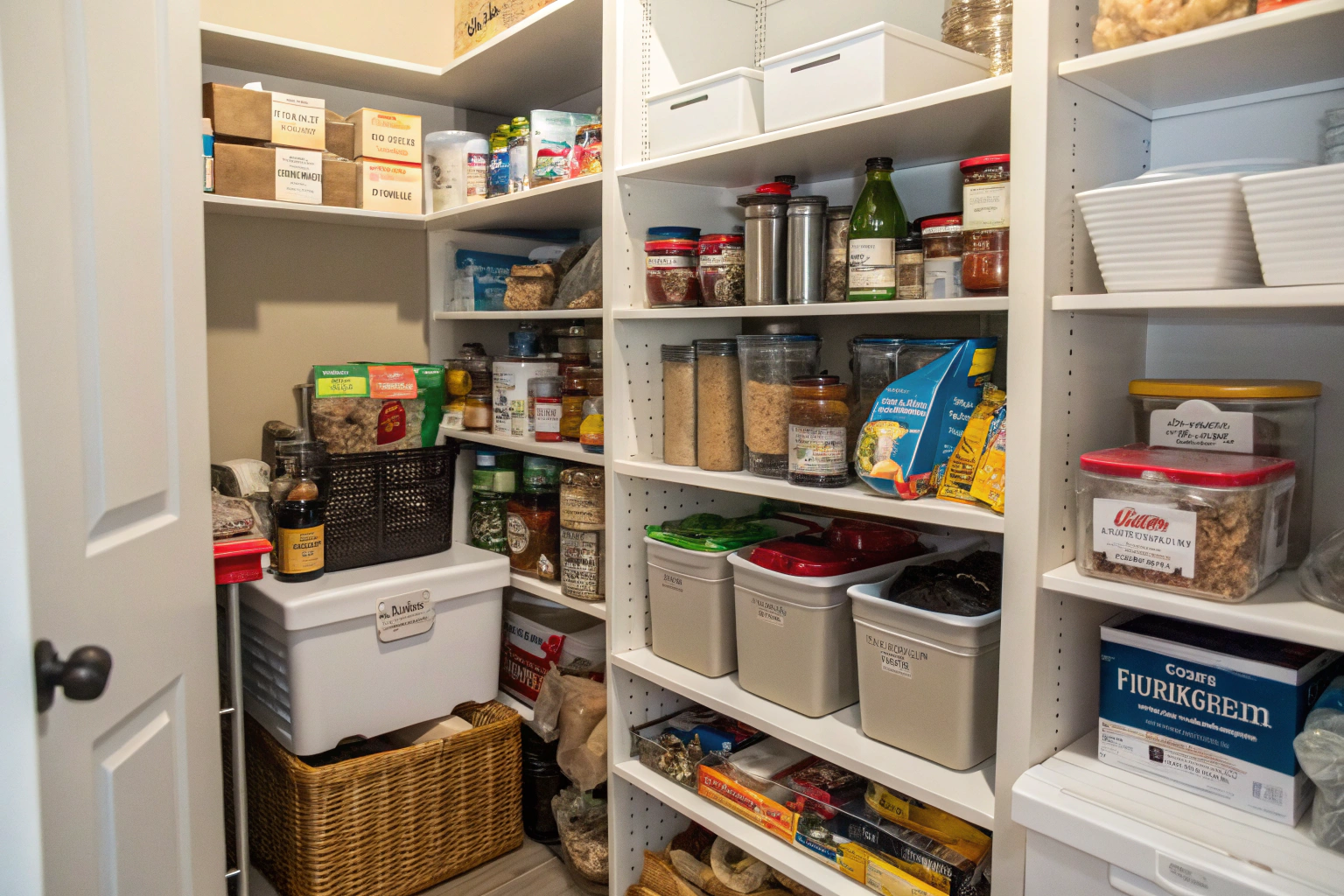
Whatever the reason you ended up with a bare pantry, the situation is the same. Four walls, a floor, possibly a light, and nothing to put anything on. The good news is that this is one of the most solvable organizational problems in the home and most of the solutions are cheaper and easier than you would expect.
1. Start With a Proper Assessment Before Buying Anything
This is the step most people skip and it is the one that saves the most money and frustration. Before ordering a single shelf or buying a single basket, spend twenty minutes understanding exactly what you are working with and what you need.
Measure Everything
Measure the width, depth, and height of your pantry interior. Write these numbers down and keep them with you when you shop. The width tells you how long your shelves can be. The depth tells you what size containers and shelving units will fit without the door being blocked. The height tells you how many shelves you can fit and whether tall items like cereal boxes and bottles will be a problem.
Pay particular attention to the depth. Many pantries are shallower than you expect and standard shelving units designed for deeper spaces will not fit properly or will prevent the door from closing. A pantry that is less than 16 inches deep needs specifically shallow shelving solutions.
Take Inventory of What You Are Storing
Pull everything out of the pantry and sort it into categories. Canned goods. Dry goods like pasta, rice, and grains. Cereals and breakfast items. Baking supplies. Snacks. Oils and condiments. Drinks and beverages. Cleaning supplies if they share the pantry. Appliances if any are stored there.
Knowing exactly what you have and in what quantities tells you how much storage you actually need, what size containers will work, and how to prioritize your shelf space. It also reveals what you have too much of, what has expired and can be thrown away, and what categories need the most organizational attention.
Think About How You Use the Pantry
Do you cook from scratch every day and need frequent access to a wide range of ingredients? Or are you a weekly meal prepper who needs organized bulk storage? Do you have children who need to access snacks independently? Do you bake regularly and need easy access to a large range of baking supplies? The answers to these questions shape which solutions will work best for your specific pantry.
2. Freestanding Shelving Units Are Your Fastest Solution
If you need organized pantry storage quickly and without any installation, a freestanding shelving unit is the single most effective solution. It goes in, it provides immediate shelf space, and if you move or change your mind you can take it with you or reconfigure it.
What to Look for in a Freestanding Pantry Shelf Unit
Adjustable shelves are the most important feature. Fixed shelves force you to work around predetermined heights that may not suit your actual groceries. Adjustable shelves let you customize the spacing so tall cereal boxes have room, short cans are not wasting space, and everything fits efficiently.
Width and depth need to match your pantry measurements from step one. For a standard pantry a unit that is 24 to 36 inches wide and 12 to 16 inches deep is usually the best fit. Check that the unit fits inside the pantry with the door able to close properly before purchasing.
Look for units with at least four to five shelves for maximum storage capacity. The more shelves the more organizational flexibility you have and the less you need to stack things on top of each other.
The Best Materials for Pantry Shelving Units
Wire shelving units are the most popular choice for pantries in 2026 and for good reason. They are affordable, sturdy, allow air circulation which helps keep dry goods fresh, and are easy to clean. The chrome or white powder-coated finishes are both practical and reasonably attractive. Wire shelving is also widely adjustable and expandable so you can add extra shelves or extend the unit as needed.
Solid wood or wood-look shelving units look more beautiful than wire and suit pantries that are open to the kitchen or visible from a living space. They are heavier, usually more expensive, and do not allow air circulation in the same way but the aesthetic payoff can be worth it depending on your priorities.
Metal wire units with a matte black finish are a popular aesthetic choice in 2026 for pantries that open into modern kitchens. They look intentional and design-forward while being practical and affordable.
Using Multiple Units Side by Side
If your pantry is wide enough, using two or three narrower shelving units side by side rather than one wide unit gives you more flexibility. You can configure them at different heights, dedicate each unit to a different food category, and reconfigure them independently if your needs change.
3. Install Wall-Mounted Shelves for a Built-In Look
If you are willing to put a few screws into the pantry walls, wall-mounted shelves give you the cleanest, most built-in look of any non-renovation option. They attach directly to the wall studs or with appropriate wall anchors, they float without visible legs or frames, and they can be positioned at exactly the heights you need.
Floating Shelves
Floating shelves in white, natural wood, or a finish that matches your kitchen cabinetry look genuinely beautiful in a pantry. They are clean, minimal, and make the pantry feel like it was designed rather than improvised. The challenge with floating shelves in a pantry is that they need to be properly anchored to hold the weight of canned goods and heavy jars. Always attach floating shelves to wall studs where possible and use appropriate heavy-duty anchors where studs are not available.
A standard can of food weighs roughly a pound. A full row of cans on a shelf can easily weigh 15 to 20 pounds. Add jars, bottles, and bags and your shelves need to be rated for significant weight. Do not underestimate this. A properly installed floating shelf from a quality manufacturer rated for the appropriate load is completely safe and reliable. A poorly installed shelf with inadequate anchoring is a risk you do not want to take.
Bracket Shelves
Shelves supported by visible brackets are slightly less elegant than true floating shelves but are generally easier to install securely and can support more weight. In 2026 brackets come in genuinely beautiful designs, thin metal brackets in matte black, brass, or white that add a design quality to the shelf rather than being purely functional. A wooden shelf on attractive metal brackets in a pantry looks intentional and stylish rather than utilitarian.
The Track and Bracket System
A wall-mounted track and bracket system is one of the most flexible wall-mounted shelving options for a pantry. You mount a vertical metal track to each wall and then click brackets into the tracks at whatever heights you choose. Shelves rest on the brackets and can be repositioned in minutes by lifting them off and moving the brackets to a different slot in the track. This system is particularly good for pantries because it allows infinite adjustment without making new holes in the wall.
4. Use an Over-the-Door Organizer
The back of the pantry door is one of the most underused storage surfaces in any home and in a shelfless pantry it becomes especially valuable. An over-the-door organizer hooks over the top of the door without any tools or installation and instantly adds a substantial amount of organized storage.
What to Look for in an Over-the-Door Pantry Organizer
Deep pockets or shelves rather than shallow ones. Shallow over-door organizers tip easily when loaded with bottles and jars. Look for pockets that are at least four to five inches deep for stability. Weight rating is important here too. A fully loaded over-door organizer carrying bottles of oil, sauce, and condiments is heavy and the organizer needs to be rated for that load.
Adjustable pocket heights are a bonus. A fixed-pocket organizer forces you to work with predetermined compartment sizes. An adjustable one lets you customize to your specific items.
What to Store in the Door Organizer
The door organizer is ideal for frequently accessed smaller items. Spice jars, condiment packets, small sauce bottles, snack bags, foil and cling wrap boxes, and similar items all work perfectly. Keep your most-reached-for items at eye level and less frequently used items at the top or bottom of the organizer.
In a shelfless pantry the door organizer can also hold a surprising amount of overflow from the main storage area. A well-chosen over-door organizer in a standard pantry can hold the equivalent of one full shelf of items which is a significant amount of space recovered from what was previously wasted.
5. Stackable Bins and Crates Are Flexible and Beautiful
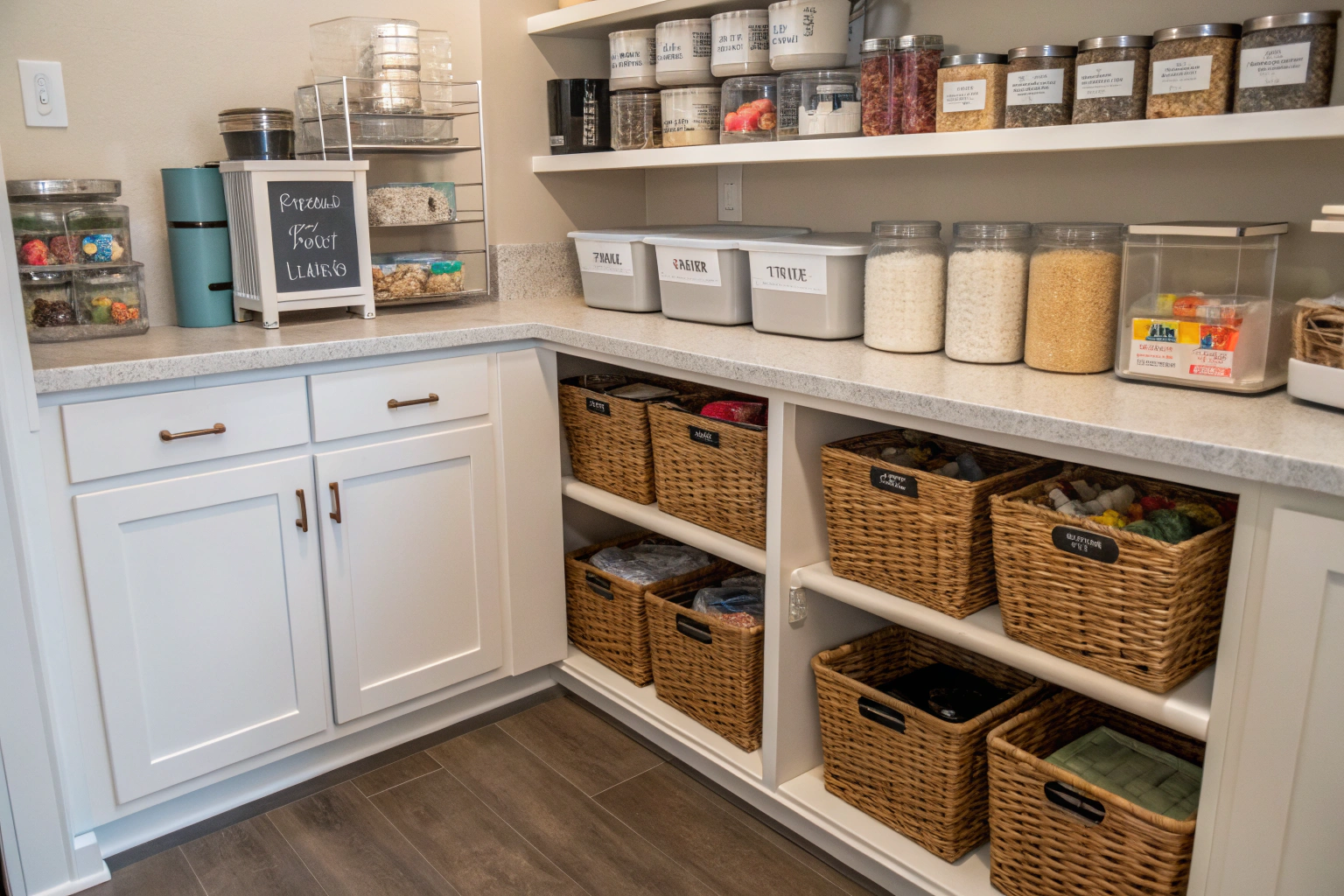
Stackable storage bins and crates are one of the most versatile and visually satisfying solutions for a shelfless pantry. They create their own structure, they can be arranged and rearranged freely, and in 2026 there are options available that look genuinely beautiful rather than purely functional.
How Stackable Bins Work in a Shelfless Pantry
Without shelves, stackable bins sit on the pantry floor and on top of each other creating a vertical storage column. Bins designed specifically for stacking have interlocking lids or slightly recessed tops that hold the next bin securely rather than allowing it to slide off. A column of three or four well-chosen stackable bins on the pantry floor creates a useful and organized storage structure without any installation.
The Best Stackable Options for 2026
Clear stackable bins are the most practical choice because you can see exactly what is inside without opening them. They are particularly good for dry goods, baking supplies, and anything you buy in bulk. Look for bins with airtight seals to keep dry goods fresh and free from pests.
Woven seagrass or rattan baskets that stack are the most beautiful option and suit pantries that open into visible living spaces where aesthetics matter. They do not allow you to see the contents from the outside so labeling becomes important.
Plastic crates in a consistent color, white or natural tones work best, stacked on the pantry floor create a structured, organized system that is easy to pull out and access like a drawer.
Color Coding by Category
A clever organizational approach using stackable bins is to assign a different color or label to each food category. All baking supplies in one set of bins, all pasta and grains in another, all snacks in a third. When everything has a designated home by category the pantry stays organized even when it is being used daily by multiple family members.
6. Use a Freestanding Kitchen Island or Cart Inside a Larger Pantry
If your pantry is large enough, a freestanding kitchen cart or small island placed inside it is a game-changing addition. It adds counter space for food prep, provides storage below in the form of shelves or drawers, and creates a central structure around which the rest of the pantry can be organized.
What to Look for in a Pantry Cart
Wheels are a significant advantage in a pantry cart. A wheeled cart can be rolled out of the pantry entirely when you need more space for a big cooking session or a pantry restock and then rolled back in when you are done. Locking wheels keep it stationary during normal use.
Shelves below the counter surface provide open storage for larger items like mixing bowls, small appliances, and bulk goods. Drawers are even better for smaller items, tools, and anything you want to keep contained. A butcher block or wooden counter surface adds warmth and is genuinely useful for food prep.
Height matters. A cart that is counter height at around 36 inches gives you a useful work surface. A cart that is shorter, around 30 to 32 inches, works better if the pantry has a lower ceiling or if you primarily want storage rather than a work surface.
7. Decant Into Matching Containers for Visual Order
This is the step that transforms a functional pantry into a beautiful one and it makes a bigger visual difference than almost any structural change. Decanting your dry goods from their original packaging into matching clear or labeled containers creates an immediate sense of order and calm that is genuinely satisfying every time you open the pantry door.
What to Decant and What to Keep in Original Packaging
Dry goods that benefit most from decanting include flour, sugar, rice, oats, pasta, cereals, nuts, seeds, coffee, and tea. These are items you use regularly, that come in bags or boxes of varying sizes that stack poorly, and that look significantly better in uniform containers.
Items that are generally fine to keep in original packaging include canned goods, bottled condiments, sealed snack bags, and anything in its original sealed packaging that you will use quickly. Decanting everything is not necessary and can become more effort than it is worth.
Container Recommendations for 2026
Square or rectangular containers make better use of shelf and floor space than round ones because they pack together without wasted gaps between them. Clear containers let you see contents and levels at a glance which means you always know when something is running low. Airtight seals keep dry goods fresh for longer.
Consistent sizing across your container collection creates the satisfying visual uniformity that makes a pantry look genuinely organized rather than just tidied. Mixing container sizes from the same range, large for flour and sugar, medium for pasta and rice, small for spices and nuts, creates a coherent look that works at every scale.
Label everything clearly. A label maker creates the cleanest and most consistent labels. Handwritten labels on kraft paper tags are a more organic and personal option that suits the aesthetic of pantries with natural wood or woven storage elements.
8. Add a Lazy Susan for Corner and Floor Space
A lazy Susan, the rotating circular tray, is one of the most practically useful pantry accessories in existence. On the floor of a shelfless pantry a lazy Susan brings items at the back into easy reach with a simple spin, eliminating the need to reach past or move items in front to get to what you need.
Where Lazy Susans Work Best in a Shelfless Pantry
A large lazy Susan on the pantry floor is ideal for oils, vinegars, sauces, and condiments. These tall bottles are difficult to stack and easy to lose at the back of a cupboard. A rotating tray brings all of them into view and reach with a single spin.
A double-decker lazy Susan is even more useful since it gives you two levels of rotating storage in the floor footprint of one. These are particularly good for spices and small jars.
A small lazy Susan on top of a stackable bin or crate creates a rotating upper level of storage that is particularly convenient for frequently accessed items.
9. Make Use of Vertical Space With Tension Rods and Hooks
In a shelfless pantry the vertical wall space is completely empty and completely unused. Tension rods and adhesive hooks are two of the cleverest and most affordable ways to start using that vertical space without any drilling or installation.
Tension Rods as Shelf Dividers and Organizers
A horizontal tension rod mounted between two walls of the pantry at an appropriate height creates an instant hanging bar for lightweight items. Hang small baskets from S-hooks on the tension rod for spice packets, sauce sachets, and small bags. Hang measuring cups, lightweight tools, or reusable bags from individual S-hooks.
Vertical tension rods mounted from the floor to the underside of a shelf create dividers that keep cutting boards, baking sheets, and pan lids upright and organized rather than stacked horizontally where they become impossible to access without moving everything.
Adhesive Hooks and Rails
Adhesive command hooks on the inside walls of the pantry hold lightweight items without any drilling. A row of hooks on the side wall holds measuring spoons, small utensils, and lightweight bags. An adhesive magnetic strip holds small metal spice tins. An adhesive rail with removable hooks creates a flexible hanging system that can be reconfigured without leaving permanent marks.
10. Light the Pantry Properly Because Organization Only Works If You Can See It
A pantry that is properly lit is significantly more functional than one that is dark. And in a shelfless pantry where you are building your own storage system from scratch, adding proper lighting is one of the most practical finishing touches you can add.
Battery-Operated LED Lights
Battery-operated LED strip lights or puck lights that stick to the underside of shelves or the inside of the pantry ceiling are a revelation in a dark pantry. They require no wiring, no electrician, and no permanent installation. Many models are rechargeable via USB which makes them even more practical. A motion-sensor version that turns on automatically when the pantry door opens is the most convenient option of all.
The Difference Good Lighting Makes
A well-lit pantry means you can see everything at a glance. You know what you have, you know where it is, and you can assess what you need to buy before going shopping. A dark pantry means things get pushed to the back and forgotten, food expires without being used, and the organizational system you carefully built gradually breaks down because nobody can be bothered to navigate it in the dark.
Lighting in a pantry is a practical investment that pays dividends in reduced food waste and reduced frustration every single time you cook.
Conclusion
A pantry with no shelves is genuinely one of the most solvable organizational problems in the home. It feels overwhelming when you are staring at four bare walls and a floor full of groceries but once you approach it systematically it reveals itself to be a straightforward challenge with a wide range of excellent solutions.
Start with the assessment because knowing your measurements and your actual storage needs prevents expensive mistakes. Then choose your primary shelving solution, whether that is a freestanding unit for immediate impact, wall-mounted shelves for a built-in look, or stackable bins for maximum flexibility. Add an over-door organizer to capture that wasted door space. Decant your dry goods into matching containers for visual order. Add a lazy Susan for easy access to items that would otherwise get lost at the back. Use tension rods and adhesive hooks for vertical wall space. And light the whole thing properly so everything you have organized can actually be seen and used.
In 2026 a beautifully organized pantry is not a luxury that requires custom cabinetry and a renovation budget. It is a few good decisions, a Sunday afternoon, and a willingness to start from scratch with intention. Your pantry has been waiting for this. It is time to give it what it needs.
Frequently Asked Questions (FAQs)
How do you organize a pantry with no shelves?
Start by measuring the pantry interior and taking full inventory of what you need to store. Then choose your primary storage structure, a freestanding shelving unit for immediate impact, wall-mounted shelves for a built-in look, or stackable bins for flexibility. Add an over-door organizer to use the door space. Decant dry goods into matching labeled containers. Use lazy Susans for rotating access to bottles and jars. Add lighting so everything is visible. Done systematically the whole project is achievable in a single day.
What is the best shelving for a pantry with no existing shelves?
A freestanding wire shelving unit with adjustable shelves is the best choice for most pantries because it is affordable, immediately available, requires no installation, allows air circulation, and can be taken with you if you move. For a more polished look, wall-mounted bracket shelves or a track and bracket system look more built-in and can be customized to exactly the heights you need. The best choice depends on your budget, how permanent you want the solution to be, and the aesthetic you are aiming for.
How do I organize a deep pantry with no shelves?
A deep pantry benefits enormously from lazy Susans which bring items at the back into reach with a simple spin. Use the front zone for daily-use items and the back zone for bulk storage and less frequently used goods. A pull-out bin or drawer system on the pantry floor means you can slide the entire contents of a section forward rather than reaching to the back. Decanting into clear labeled containers helps because you can see exactly what is stored at the back without moving everything in front.
How do I organize a small pantry with no shelves?
Maximize vertical space immediately by using wall-mounted shelves that go all the way to the ceiling. Use the door with a heavy-duty over-door organizer. Choose stackable containers that use vertical space efficiently. Keep only what you genuinely use regularly in the pantry and store bulk or overflow items elsewhere. A small well-organized pantry with every inch used intentionally functions far better than a larger pantry where space is wasted.
What should go in a pantry organizer?
The most useful categories to organize in a pantry are dry goods like pasta, rice, and grains in airtight containers, canned goods grouped by type, baking supplies together in one zone, snacks in baskets or bins, oils and condiments on a lazy Susan or door organizer, cereals and breakfast items on an accessible shelf, and spices either on a dedicated spice rack or in a lazy Susan. Keep everyday items at eye level, less frequently used items higher up, and heavy items like large cans and bottles lower down.
How do I make my pantry look nice without spending a lot?
Decanting dry goods into matching clear containers makes the single biggest visual difference for the lowest cost. Adding matching labels takes it even further. Consistent baskets or bins in the same material and color create visual order from existing chaos. A fresh coat of white or light paint on the pantry interior walls makes everything feel cleaner and brighter. Battery-operated LED lighting makes the space feel more intentional. None of these changes require significant investment but together they transform how the pantry looks and feels.
Can I add shelves to a pantry without drilling?
Yes. Freestanding shelving units require no drilling at all and provide immediate shelf space. Tension rod shelf systems create shelves between two parallel walls without drilling. Some heavy-duty adhesive mounting systems can support lightweight shelves if the wall surface is suitable, though these are not recommended for shelves holding heavy canned goods. A track and bracket system mounted to studs is the most secure non-renovation option that still allows complete flexibility and reconfiguration.
How do I keep my pantry organized once I have set it up?
The key is having a designated home for every category of item and returning things to that home consistently. Decanted containers with clear labels make this significantly easier because there is no ambiguity about where things belong. A weekly five-minute pantry reset, wiping shelves, returning stray items to their zones, and checking what needs replenishing, keeps the system functioning long term. Shopping from a list rather than buying impulsively also prevents the pantry from becoming overstocked with items that have no designated home.

- Why Pantry Organization Never Lasts (And What Actually Works) - March 26, 2026
- How to Organize a Pantry That Has No Shelves (2026 Guide) - March 26, 2026
- How to Style a Staircase Landing as a Reading Nook Without Renovation (2026 Guide) - March 26, 2026