Neo Deco Interior Design: The Complete Style Guide
Everything you need to understand, apply, and live with Neo Deco style, from the geometry and glamour of its Art Deco roots to the modern material choices, statement furniture, and dramatic details that define it today.
KEY POINTS
- Neo Deco is Art Deco reinterpreted for the modern home. It keeps the drama, the geometry, and the commitment to materials of genuine quality, while losing the period-room formality that made original Art Deco feel like a museum.
- The style works through bold contrasts: dark against light, matte against reflective, curved against angular. Every room needs a tension between opposites to achieve the characteristic Neo Deco energy.
- Getting Neo Deco right is largely a question of restraint. The temptation is to do everything at once. The rooms that actually work choose three or four signature elements and execute them impeccably.
Art Deco was never subtle. It emerged in the 1920s as a deliberate celebration of luxury, geometry, and the machine age, and it produced interiors of extraordinary drama and confidence. The problem with pure Art Deco in a contemporary home is that it can easily tip from dramatic to theatrical, from luxurious to overwrought, and from confident to period-costume. Neo Deco solves this by taking the vocabulary of the original and filtering it through a modern eye: the bold geometry stays, the rich materials stay, the commitment to craft stays, but the heavy formality and the period-specific details are edited away.
Love Chic Living Club?
Add us as one of your preferred Google sources and discover more home decor, DIY, outdoor, and lifestyle inspiration from us.
The result is a style that feels genuinely contemporary while carrying the weight and presence that most current design trends lack. A Neo Deco room has atmosphere. It makes you feel something when you walk into it. This guide covers how to create that atmosphere without tipping into pastiche, from the foundational decisions about colour and material to the specific elements that give this style its unmistakable character.
RELATED: 19+ Neo Deco Interior Ideas That Feel Current, Not Dated
What Makes Neo Deco Different From Regular Art Deco
The original Art Deco movement, which peaked in the 1920s and 1930s, was defined by several qualities: bold geometric patterns, an unapologetic love of luxury materials, strong symmetry, and a palette that typically combined dark backgrounds with metallic accents. The furniture was formal, the scale was often grand, and the overall effect was one of deliberate opulence that belonged to hotels, ocean liners, and the homes of the very wealthy.
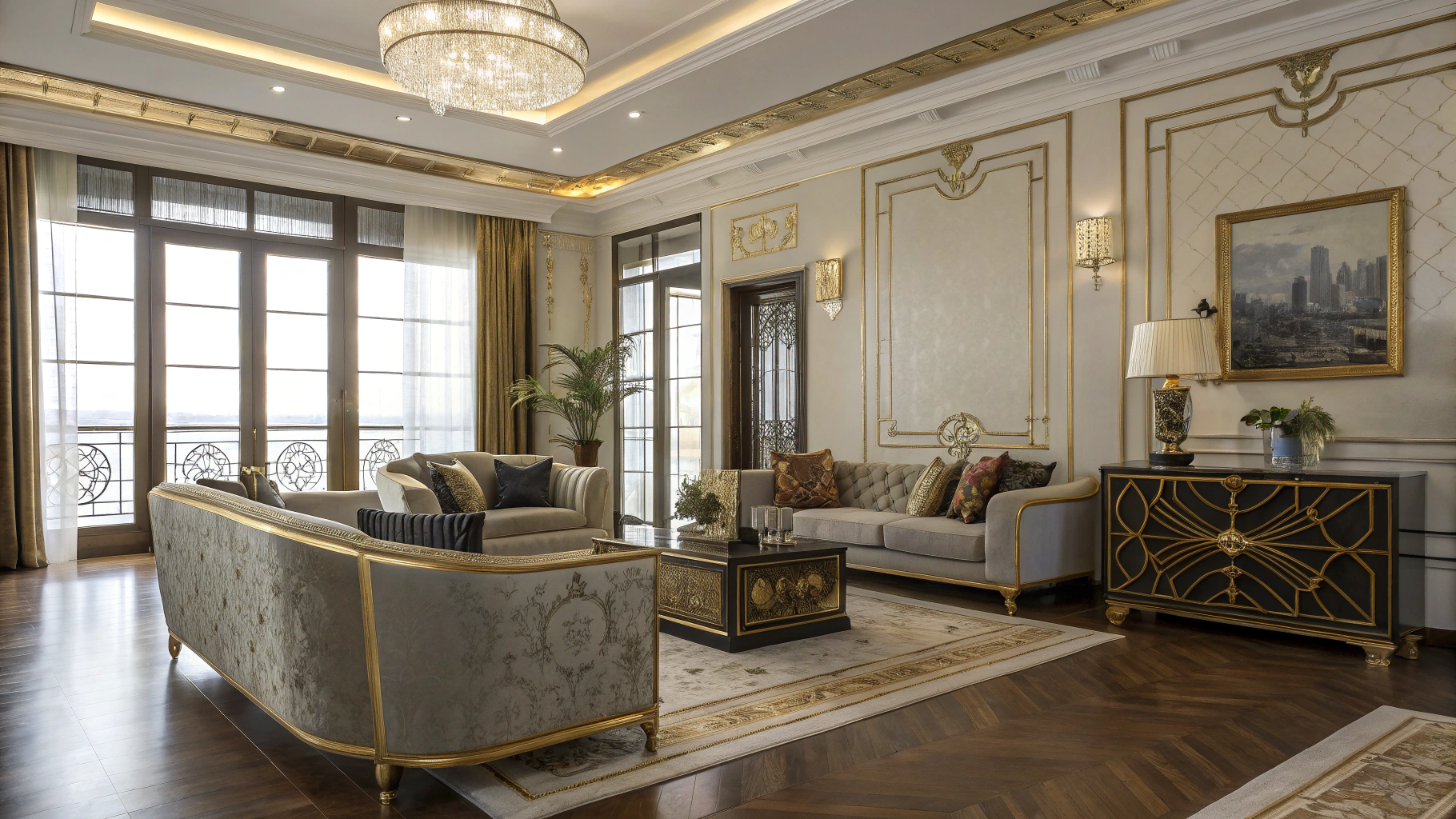
Neo Deco takes the essential spirit of all of this and makes it liveable for a modern home. The geometric forms remain but they appear in furniture profiles and hardware rather than in elaborate inlaid floors and carved ceilings. The luxury materials remain but they are used more selectively, as a single marble surface, a velvet upholstered piece, a brass fixture, rather than as the dominant material of every surface in the room. The symmetry remains in the arrangement of furniture and the placement of objects, but it is balanced against more relaxed, contemporary elements that prevent the room from feeling like a stage set.
The single most important distinction is that Neo Deco is a confident style rather than a period style. It does not recreate the 1920s. It uses the visual language of the 1920s to create spaces that feel decisive and dramatic in the present.
The Neo Deco Colour Palette
The palette of a Neo Deco interior is one of its most immediately distinctive features. Where most contemporary design trends favour pale neutrals and cautious colour, Neo Deco commits to depth, richness, and the kind of contrast that makes a room feel genuinely dramatic.
Deep, saturated backgrounds are the foundation: forest green, midnight navy, warm charcoal, rich burgundy, and warm black all provide the dark ground against which the style’s metallic accents and lighter elements read with maximum impact. These are not the timid, greyed-down versions of these colours that appear in more cautious contemporary interiors. They are full, confident tones applied to walls, upholstery, and cabinetry with the conviction that a room can absorb depth without feeling oppressive.
On top of that dark ground, the palette introduces its contrasting elements: the warm gold of brass hardware and accessories, the cool gleam of chrome or polished nickel, the clean white or cream of marble veining and light upholstery, and the rich jewel tones of deep teal, amber, and ruby that appear in glass, textiles, and accent objects. The contrast between these elements, dark against light, matte against reflective, warm against cool, is what gives Neo Deco its characteristic energy and visual tension.
Brass: The Defining Metal
If there is a single material that defines Neo Deco more than any other, it is brass. Not the pale, lemon-yellow brass of the 1980s, but the warm, amber-toned unlacquered or brushed brass that has a depth and richness reminiscent of the original Art Deco period while feeling entirely current.
Brass works in a Neo Deco interior because it does two things simultaneously: it introduces warmth into a palette that might otherwise feel cold, and it provides the reflective, metallic element that gives the style its glamour. A dark room with brass hardware, brass light fixtures, and a few well-placed brass accessories has a quality of warm luminosity that chrome or matte black cannot achieve.
The brass decor styling ideas for living rooms that work best in a Neo Deco context treat brass as a consistent accent throughout the room rather than as a detail in one corner. When the light fixture, the side table legs, the mirror frame, and the decorative objects all share the same warm metal finish, the room acquires a coherent material language that feels designed rather than assembled. The brass accents in contemporary interiors that feel most modern are the ones where the brass is used sparingly enough to feel precious rather than so pervasively that it reads as a theme. And the specific brass decor pieces that add luxury immediately are worth understanding before shopping, because not all brass applications carry the same visual weight.
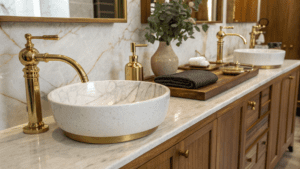
The combination of brass with marble and warm timber is one of the most reliable material pairings in Neo Deco design. The brass aesthetic paired with marble and wood produces a trinity of materials that feels genuinely rich without requiring expensive construction, because the three materials do their best work as accents and surfaces rather than as structural elements.
RELATED: 17+ Brass Decor Styling Ideas That Elevate Any Room
You May Also Love
Lighting as Drama
Lighting in a Neo Deco interior is not a background element. It is a design statement. The fixtures themselves are sculptural objects that contribute to the room’s character even when switched off, and when lit they create the pools of warm, focused light that give Neo Deco its atmospheric quality.
The pendant lamp is the signature lighting choice of this aesthetic, and getting it right makes an enormous difference to how the room feels. A statement pendant lamp in glass and brass, in a geometric profile that references Art Deco form while using contemporary materials, becomes the focal point of a dining room or living room in a way that a simple flush ceiling fitting never could. For rooms with high ceilings, the pendant also addresses the visual challenge of bringing the ceiling down to a human scale, creating a sense of enclosure and intimacy in a room that might otherwise feel cavernous.
The pendant lamp styling in living and dining areas that works most effectively in a Neo Deco context positions the fixture as the anchor of the room’s vertical composition, with everything below it arranged in deliberate response to its presence. The fixture sets the height at which the eye is meant to rest, and the furniture arrangement beneath it creates the horizontal plane that the vertical fixture commands.
Beyond pendants, wall sconces in brass or bronze with fabric or glass shades add the layered, warm lighting that makes a Neo Deco room feel genuinely atmospheric in the evenings. Table lamps in ceramic or stone bases with pleated or gathered shades bring a quality of traditional craftsmanship that complements the style’s love of material luxury.
The Leather Banquette
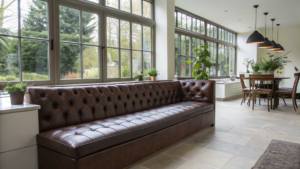
One of the most distinctive furniture pieces associated with Neo Deco design is the leather banquette, and its popularity is a direct expression of the style’s willingness to commit to bold, characterful choices rather than safe, neutral ones. A leather banquette, properly scaled and properly positioned, transforms a dining area or a living corner into something that feels like a considered design decision rather than furniture that has been placed somewhere.
The leather banquette trends that have made this piece one of the most searched furniture items in contemporary interior design reflect a broader appetite for materials with genuine presence and weight. Leather ages beautifully, develops character with use, and has a sensory richness that upholstered fabric cannot match. In a Neo Deco context, it also brings the period connection to the lounges and dining rooms of the 1920s and 1930s that gives the style its historical depth.
The leather banquette seating ideas that feel luxurious are not necessarily the most expensive configurations. A simple straight banquette upholstered in a warm cognac or deep burgundy leather, positioned along one wall of a dining room with a marble-topped table in front of it and brass pendants above, achieves the full Neo Deco effect at a fraction of the cost of more elaborate configurations. For homes with open plan layouts, a leather banquette also serves the practical function of defining the dining zone within a larger floor plan without requiring a separate room.
For smaller spaces where a dining room is not available and the eating area is shared with the kitchen or a corner of the living space, a leather banquette built into a corner or along a wall creates a proper dining nook that feels genuinely considered rather than provisional. The warm neutral leather banquette styling ideas that use camel, cognac, and warm tan tones rather than black or stark white integrate more naturally with a broader range of room palettes and feel less formal in a space that needs to work for everyday use as well as entertaining.
RELATED: 17+ Leather Banquette Trends Making a Comeback
Don't miss: 15+ Antique Bar Cart Decor Ideas Using Brass and Glass →
Red Marble: The Boldest Material Statement
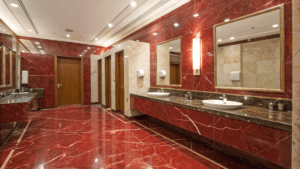
If brass is the defining metal of Neo Deco, red marble is its most dramatic material statement. Red marble, with its deep crimson ground veined in white, gold, or black, is one of those materials that makes an immediate and unmistakable impact in any room it appears in. It is not a subtle choice. It is a commitment to drama and visual presence that few other materials can match.
In a Neo Deco bathroom, red marble creates an atmosphere of genuine luxury that transforms the room from a functional space into something closer to a stage set for daily ritual. The red marble bathroom trends that define Neo Deco style use this material on walls, floors, or vanity surfaces in ways that commit fully to the material’s drama rather than hedging it with neutral surroundings. The red marble bathroom ideas that feel dramatic yet refined show how the material can be controlled through the choices made around it: brass hardware, white ceramic fixtures, and minimal additional decoration allow the marble to be the statement rather than competing with it.
For those concerned that red marble will feel overwhelming, the red marble bathrooms that balance bold and elegant demonstrate how proportion and restraint in application prevent the material from tipping into excess. Using red marble on one feature wall rather than every surface, paired with warm white tiles elsewhere, creates contrast that makes both materials more visible and more appreciated. The red marble design ideas for small bathroom spaces address the specific challenge of using a bold material in a limited footprint, showing that scale does not limit the impact a material can achieve.
The Antique Bar Cart
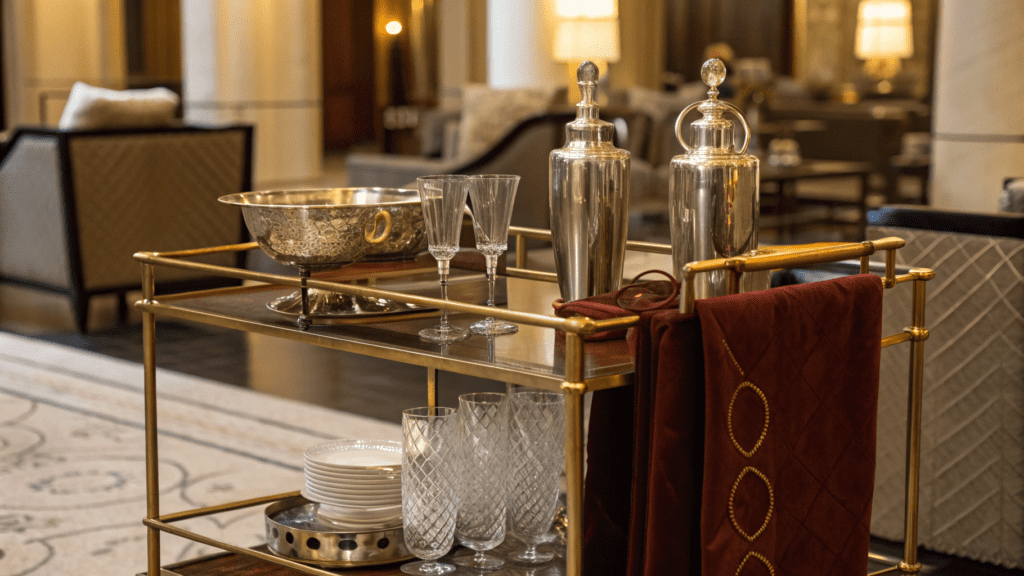
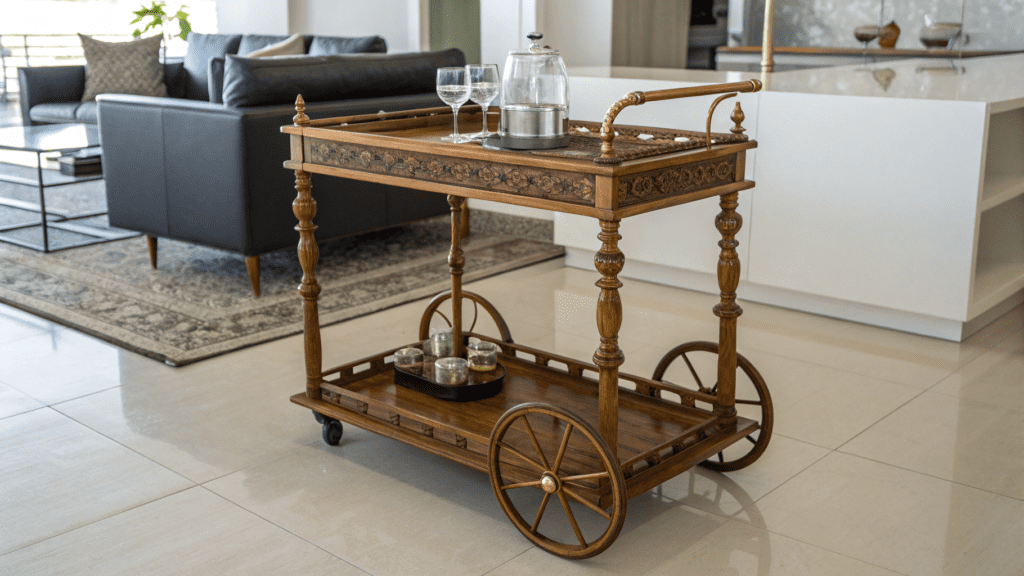
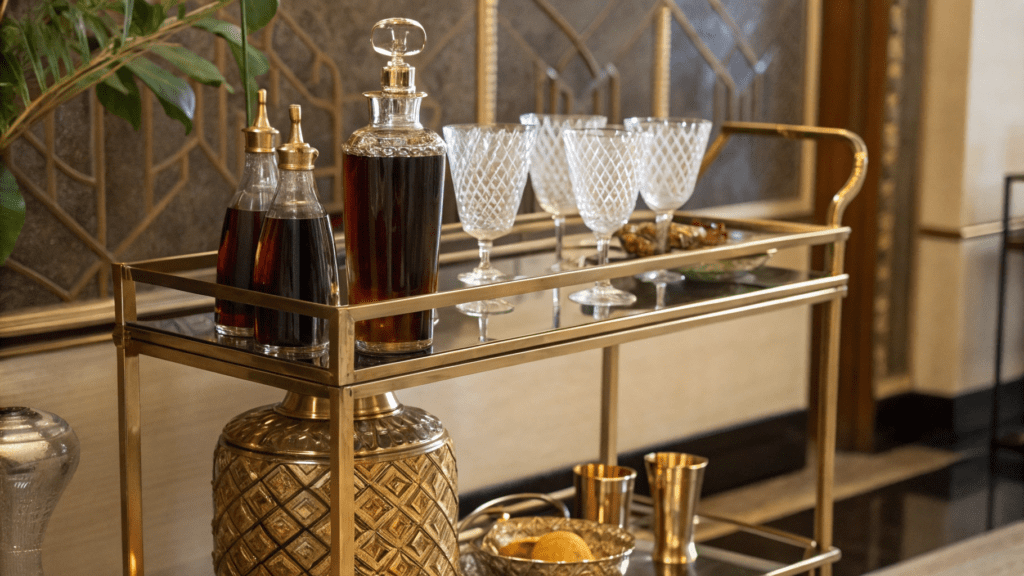
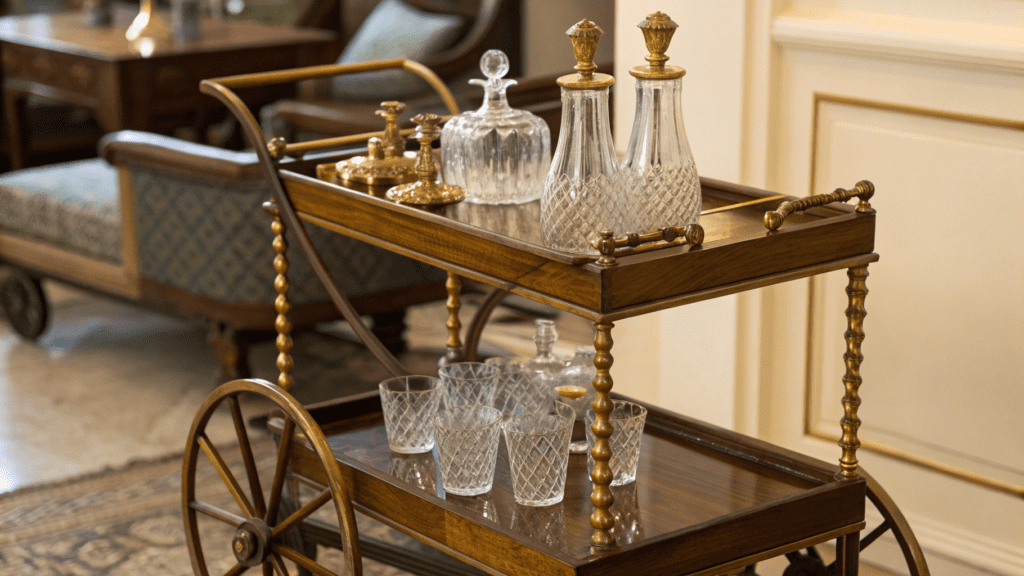
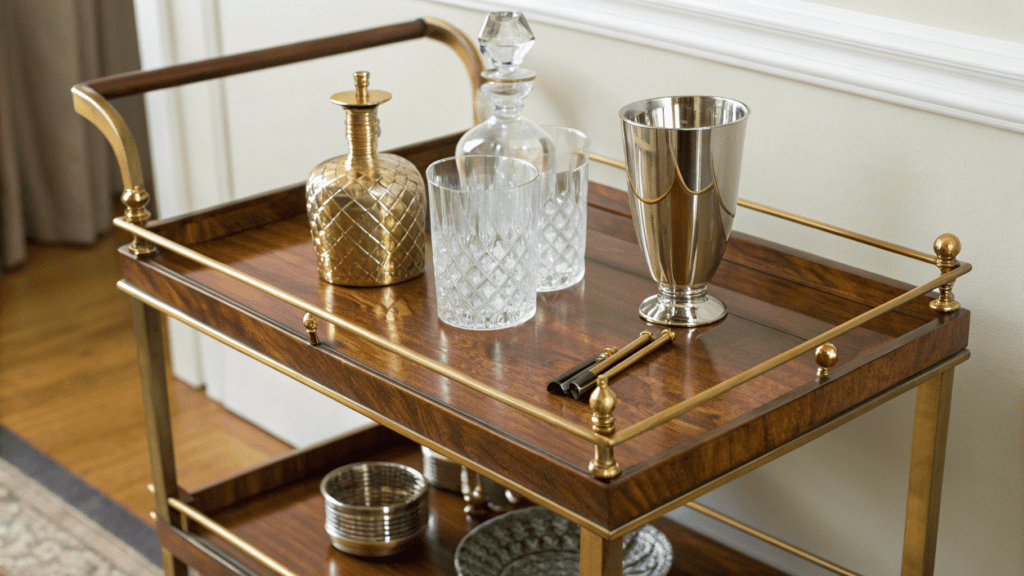
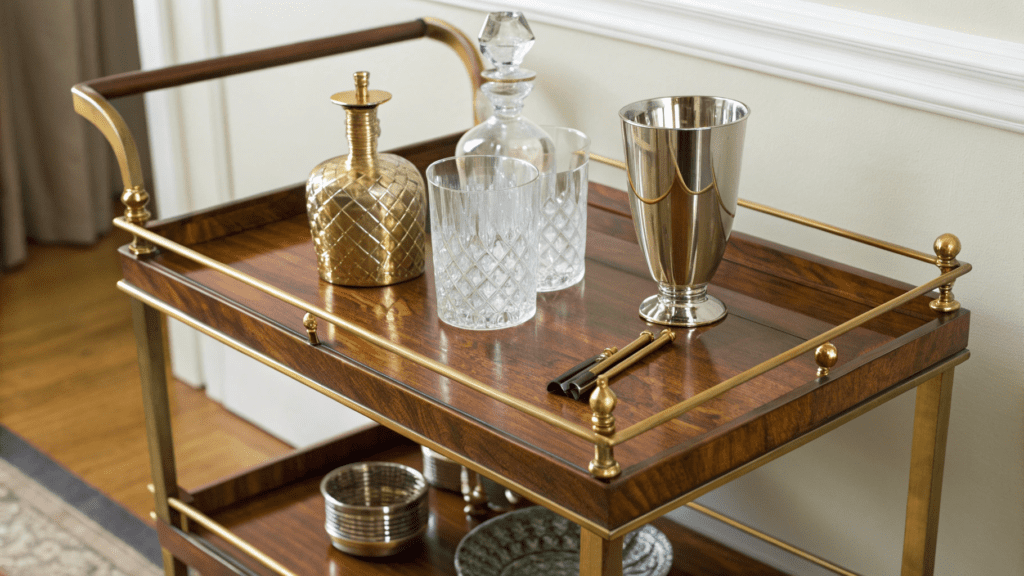
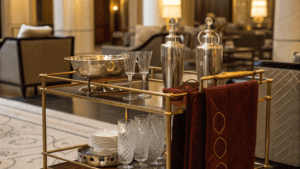
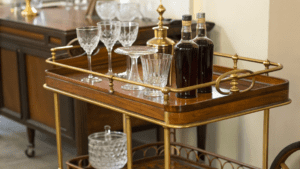
The antique bar cart is the Neo Deco piece that most directly expresses the style’s connection to the glamour of the interwar period. A brass-framed cart with glass shelves, crystal decanters, and cut-glass tumblers evokes the cocktail culture of the 1920s and 1930s with an immediacy that no contemporary bar cart achieves, and it does so while serving an entirely practical function in the modern home.
The antique bar cart trends that have defined Neo Deco interiors in recent years reflect the broader appetite for objects with history and character in an era of mass-produced furniture. A well-chosen antique bar cart, or a quality reproduction with genuine brass and glass construction, becomes one of the most noticed and most admired pieces in any room it occupies. The antique bar cart styling for living rooms that photographs most consistently well treats the cart as a composed display rather than a functional storage unit: a few beautiful decanters at varying heights, a small arrangement of glassware, a plant, and one or two decorative objects that share the brass and glass material language of the cart itself.
The antique bar cart decor ideas using brass and glass go into the specific combinations of materials and objects that create the most cohesive and most luxurious-looking cart styling. The key insight is that the cart looks best when the objects on it are limited in number and consistent in quality: three or four things chosen well outperform twelve things placed without discrimination. The approach to styling an antique bar cart without overcrowding makes this principle concrete, showing exactly what to include and what to leave off.
For smaller homes and apartments, the antique bar cart styling ideas for small apartments address how to incorporate this piece in spaces where floor area is limited. The antique bar carts that elevate entertaining spaces show the full range of what is possible when the cart is positioned and styled with real intention, and the art deco-influenced antique bar cart setups go deepest into the historical connection between the bar cart and the design period that Neo Deco draws from. Even in a fully contemporary home, an antique bar cart functions as the most effective single piece for introducing the Neo Deco sensibility without committing to a full room renovation.
RELATED: 14+ Antique Bar Cart Decor Setups With Art Deco Influence
Geometry and Pattern
One of the defining visual characteristics of Art Deco was its love of geometric pattern, and Neo Deco carries this forward in the forms of furniture, the profiles of hardware, and the pattern choices for floors, tiles, and textiles. Where the original Art Deco applied geometric pattern to almost every surface, Neo Deco uses it more selectively: as the profile of a mirror frame, the pattern in a tiled floor, the shape of a light fixture, the silhouette of a chair.
The most reliable places to introduce geometric form in a Neo Deco interior are the elements that are seen most often and from the greatest distance. A large geometric mirror above a fireplace or a console makes the pattern visible from every position in the room. A chevron or herringbone tiled floor in a hallway or bathroom establishes the geometric vocabulary at the entry to the space. Furniture with angular legs and rectangular or octagonal profiles introduces the silhouette without requiring surface pattern.
The tension between geometric form and organic material is what makes Neo Deco feel current rather than period-specific. A perfectly symmetrical octagonal mirror in unlacquered brass above a raw marble console is a Neo Deco composition precisely because the precision of the geometry is in dialogue with the natural variation of the marble. The geometry provides the structure; the material provides the life.
Keep Exploring
How to Introduce Neo Deco Without a Full Renovation
The full Neo Deco room, with dark walls, marble surfaces, leather upholstery, and brass fixtures throughout, is a significant undertaking. For most people, the more practical approach is to introduce the style’s vocabulary into an existing room through specific pieces and decisions rather than a complete overhaul.
TIP: Start with the metal finish. Replacing every piece of hardware in a room, light switches, door handles, and cabinet knobs to a consistent unlacquered or brushed brass creates the warm, cohesive metallic foundation of Neo Deco without touching the walls, the floor, or the furniture. This single change, which costs relatively little and can be done over a weekend, shifts a room’s material language more dramatically than almost any other intervention of equivalent effort.
A statement pendant in brass and glass above the dining table or in the living room. A leather banquette or a velvet sofa in a deep jewel tone. A marble side table. An antique bar cart positioned as a focal point rather than tucked against a wall. A large geometric mirror with a brass frame. Any three of these pieces introduced into an existing room will begin to shift its character toward the Neo Deco aesthetic in a way that feels considered rather than themed.
The antique bar cart styling ideas that feel luxe, not old show how a single well-chosen vintage or reproduction piece can anchor the Neo Deco sensibility in a room that is otherwise entirely contemporary.
Frequently Asked Questions
What is Neo Deco style?
Neo Deco is a contemporary design aesthetic that draws on the visual language of 1920s and 1930s Art Deco design: bold geometry, rich materials, metallic accents, and dramatic colour contrasts. It reinterprets these elements for a modern home, keeping the drama and the material quality while losing the period-room formality and the heavy ornamentation of the original movement.
What colours work best in a Neo Deco interior?
Deep, saturated backgrounds form the foundation: forest green, midnight navy, warm charcoal, rich burgundy, and warm black. These are contrasted with warm metallic accents in brass and bronze, clean white or cream from marble surfaces and light upholstery, and jewel-toned accents in teal, amber, and deep ruby. The contrast between dark and light, warm and cool, matte and reflective is what gives Neo Deco its energy.
How do I add Neo Deco style without redecorating completely?
Start with the metal finish throughout the room, replacing existing chrome or steel hardware with brushed or unlacquered brass. Add one statement light fixture in a geometric profile. Introduce a marble surface, either an existing piece recovered with marble-effect laminate or a genuine marble side table. These three changes establish the Neo Deco vocabulary in any room without requiring structural change.
Is Neo Deco appropriate for small rooms?
Yes, with specific considerations. In a small room, Neo Deco works best through the quality and finish of individual elements rather than through the full palette and furniture set. A small bathroom with red marble on one feature wall, brass fixtures, and a geometric mirror achieves the full Neo Deco impact in a minimal footprint. A leather banquette in a dining nook transforms a small eating area into something genuinely dramatic. The style’s commitment to material quality means that even one well-chosen piece in a small room carries significant weight.
What is the difference between Neo Deco and maximalism?
Neo Deco is maximalist in its commitment to drama and material richness, but it is not maximalist in the sense of accumulation. The style works through the selection of a few exceptional elements chosen for their geometric form, their material quality, and their ability to create contrast, rather than through the layering of many things. A Neo Deco room has fewer objects than a true maximalist room, but each object has more presence.
Explore the full range of home decor styles in our Styles section at Chic Living Club.