How to Install Peel-and-Stick Wallpaper Step by Step (A Simple Guide)
Peel-and-stick wallpaper is one of those home improvement developments that sounds too good to be true until you actually try it. A wallpaper you can apply yourself without paste, without a steamer, without professional help, and without committing to it permanently? One that you can remove cleanly when you want a change without damaging your walls? That actually looks genuinely beautiful when it is done properly?
All of that is real and in 2026 the quality of peel-and-stick wallpaper has reached a point where even interior designers who spent years dismissing it as a cheap alternative to real wallpaper are using it in client projects. The patterns are better, the materials are more durable, the adhesive backing has improved significantly, and the range of textures and finishes available has expanded enormously.
The catch, and there is one, is that peel-and-stick wallpaper is not quite as simple as its name implies. Peeling and sticking is the easy part. Getting it to look genuinely beautiful, with perfectly aligned patterns, no bubbles, no lifting edges, and clean precise cuts around switches and skirting boards requires a process that most people do not know before they start. Which is exactly why this guide exists.
Follow the steps here and your peel-and-stick wallpaper installation will look like it was done by a professional. Skip the steps or rush through them and you will end up with a wall that looks like someone tried and gave up halfway through.
Love Chic Living Club?
Add us as one of your preferred Google sources and discover more home decor, DIY, outdoor, and lifestyle inspiration from us.
What Makes Peel-and-Stick Wallpaper Different From Traditional Wallpaper
Understanding the fundamental differences between peel-and-stick and traditional pasted wallpaper helps you understand why the installation process works the way it does and why certain steps that seem unnecessary are actually critical.
Traditional wallpaper is applied with paste that provides adhesion and also allows the paper to be repositioned slightly as it goes up. The paste has a working time during which the paper remains somewhat movable. Once dry the adhesion is permanent and removal requires steaming or soaking and is a major project.
Peel-and-stick wallpaper has a pressure-sensitive adhesive backing covered by a release liner. When the liner is removed and the wallpaper is pressed against the wall the adhesive bonds on contact. The adhesive is designed to be removable which means it bonds less aggressively than permanent adhesives and can be pulled away from the wall without damaging the surface when properly applied and removed.
The pressure-sensitive nature of the adhesive is why surface preparation is so important. The adhesive relies on direct contact with a clean, smooth, properly primed surface. Any dust, grease, texture, or moisture between the adhesive and the wall reduces the bond and causes lifting, bubbling, and premature failure. Every surface preparation step in this guide exists to maximize the contact quality between the adhesive and the wall.
Before You Buy: Calculating How Much You Need
Getting the quantity right before you buy is important because running out mid-project and having to order more can mean waiting days for delivery and finding that a new batch differs very slightly in color from the first. Over-ordering by a comfortable margin is the right approach.
Measuring Your Wall
Measure the width and height of each wall section you are covering. Multiply width by height to get the square footage or square meterage. Add ten percent to your total for waste from pattern matching, trimming, and mistakes. If your chosen wallpaper has a large pattern repeat add an additional ten to fifteen percent to account for the extra waste that pattern matching creates.
For a feature wall in an average bedroom, between twelve and sixteen square meters of wallpaper is typically sufficient with waste factored in. Always check the coverage information on the specific product you are buying since roll widths vary between manufacturers and affect how many rolls you need for a given area.
Pattern Repeat Considerations
If your chosen wallpaper has a pattern repeat, which means the pattern element repeats at regular intervals down the length of the roll, you will need more wallpaper than a solid or non-directional pattern requires. A large pattern repeat of thirty centimeters or more can add twenty to thirty percent to your material requirement because you need to align each strip to the same point in the pattern which wastes the material between where the previous strip ended and where the pattern aligns for the next strip.
For your first peel-and-stick wallpaper project a small pattern repeat or no repeat at all is significantly easier to work with and wastes considerably less material.
Tools and Materials You Need
The good news is that peel-and-stick wallpaper installation requires very few tools and most of them are inexpensive or already in your home.
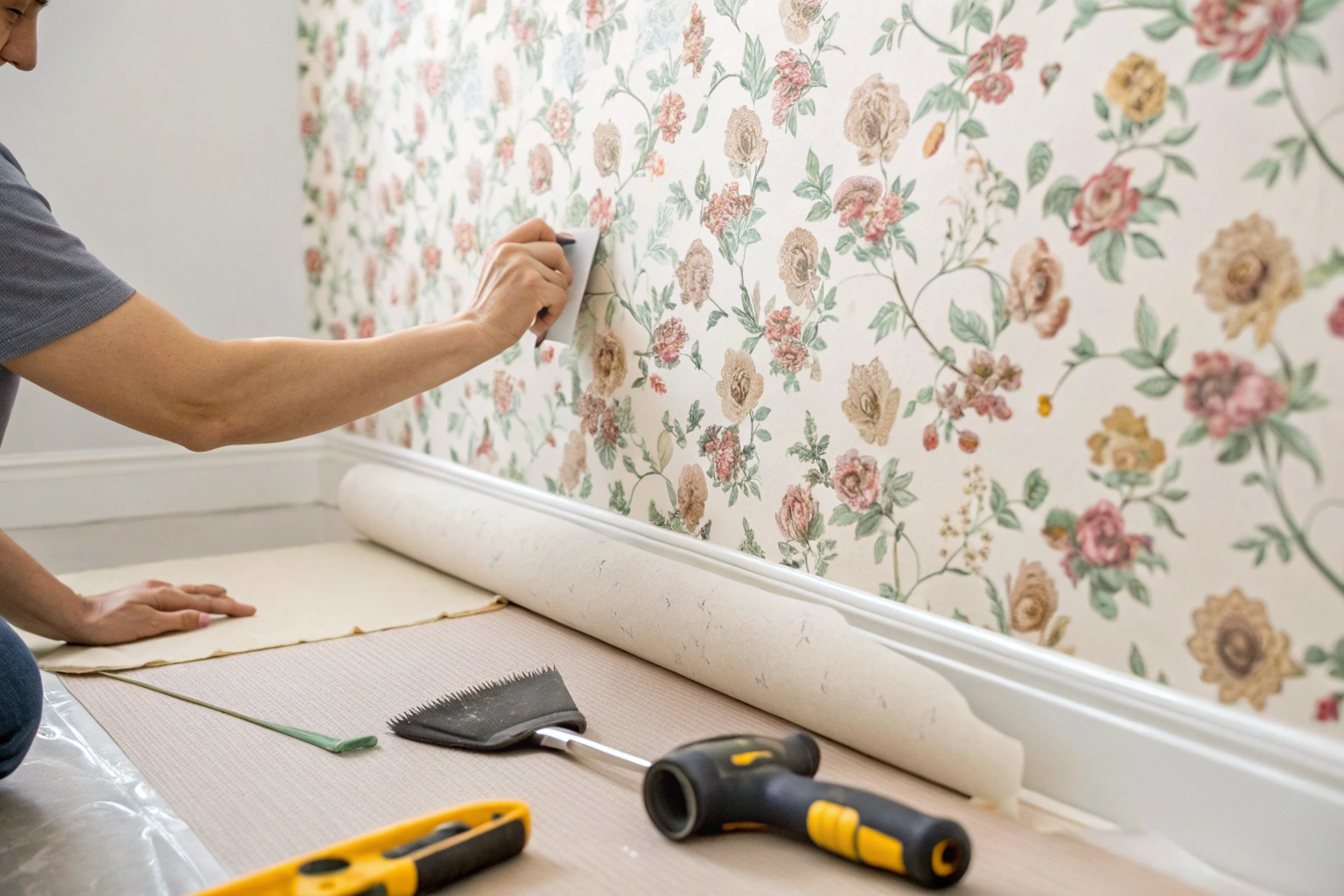
A smoothing tool or wallpaper squeegee is the most important specialist tool. This is a flat, firm implement used to press the wallpaper firmly and evenly against the wall from the center outward, pushing out air bubbles and ensuring maximum adhesive contact. A dedicated wallpaper smoothing tool costs five to ten dollars. A credit card, a library card, or a ruler wrapped in a soft cloth are workable alternatives for small projects.
A sharp craft knife or utility knife with fresh blades is essential for clean, precise cuts. A blade that is even slightly dull tears the wallpaper rather than cutting it cleanly which ruins the appearance of the finished installation particularly at edges and corners. Change the blade frequently throughout the project. A fresh blade is one of the most impactful small investments you can make for a clean result.
A metal straightedge or long ruler is needed as a guide for straight cuts. Cutting freehand along a wall edge or around a fixture produces wavy, imprecise edges that are visible in the finished installation. A metal straightedge ensures perfectly straight cuts every time.
A level is needed to ensure your first strip is perfectly vertical. Even a small deviation from vertical in the first strip will compound as you add more strips until the pattern is visibly off-angle across the wall. A small spirit level or a smartphone level app both work fine.
A measuring tape for measuring and marking strip positions. A pencil for marking light guidelines on the wall. A clean lint-free cloth for wiping surfaces. Scissors for rough trimming before final cuts. A step ladder for reaching the top of the wall.
Step One: Prepare the Wall Surface Thoroughly
Wall preparation is where most peel-and-stick wallpaper installations succeed or fail and it is the step that most people underinvest in because it does not feel like progress. Preparing the wall feels like delaying the fun part. But a poorly prepared wall is the primary cause of every common peel-and-stick wallpaper problem including bubbling, lifting edges, and the wallpaper falling off entirely.
Clean the Wall Completely
Wash the wall with a mild cleaning solution, a small amount of dish soap in warm water works perfectly, using a clean cloth or sponge. Work methodically from top to bottom and pay particular attention to areas near light switches, near the floor, and near furniture that may have accumulated grease or grime. Kitchen walls and walls near cooking areas need particularly thorough cleaning since cooking grease creates an invisible film that prevents adhesive bonding.
Allow the wall to dry completely after washing. This typically means waiting at least twenty four hours in normal conditions. A wall that feels dry to the touch may still contain moisture that will compromise adhesive bonding. In humid conditions or during wet weather allow longer drying time.
Repair Any Damage First
Fill any holes, cracks, or imperfections in the wall surface before applying wallpaper. Peel-and-stick wallpaper does not hide wall imperfections the way thick traditional wallpaper sometimes can. Bumps, holes, and cracks telegraph through the wallpaper and are visible in the finished installation particularly in raking light. Fill, sand smooth, and allow repairs to fully dry before proceeding.
Check the Wall Type and Condition
Peel-and-stick wallpaper adheres best to smooth, sealed surfaces. Freshly painted walls in good condition with a flat, eggshell, or satin finish are ideal. Textured surfaces like heavily textured paint, artex, or rough plaster reduce the adhesive contact area significantly and lead to poor adhesion. Smooth the texture if possible or accept that performance on textured surfaces will be compromised.
New paint needs to cure fully before wallpaper is applied. Paint may feel dry within hours but it continues to cure and harden for several weeks after application. Applying peel-and-stick wallpaper to paint that has not fully cured risks the adhesive bonding more strongly to the uncured paint than intended which can cause paint to peel away from the wall when the wallpaper is removed. Wait at minimum four weeks after painting before applying peel-and-stick wallpaper to new paint.
If the wall has a flat matte paint finish, applying a coat of eggshell or satin paint over it before wallpapering significantly improves adhesion because the slightly harder, less porous surface provides better contact for the pressure-sensitive adhesive.
Step Two: Plan Your Layout Before You Peel Anything
Planning your layout before applying a single strip is one of the most important steps in achieving a professional-looking result and it is the step that distinguishes experienced installers from first-timers.
Find the Center of the Wall or Choose a Starting Point
For a feature wall the most visually balanced approach is to center the pattern on the wall and work outward in both directions. This ensures that if the wallpaper ends in a partial strip at each side wall the partial strips are symmetrical which looks intentional. An asymmetric arrangement where one side has a full strip and the other has a narrow sliver looks accidental.
To find the center of the wall measure the total width and divide by two. Mark the center point lightly with a pencil at the top, middle, and bottom of the wall. This becomes the center line of your installation.
For rooms with a strong focal point such as a fireplace or a prominent piece of furniture, centering the pattern on that focal point rather than the geometric center of the wall can produce a more visually satisfying result.
Mark Vertical Guidelines
Use your level and a pencil to mark a perfectly vertical line on the wall where your first strip will sit. This is the single most important line you will draw because every subsequent strip aligns to the previous one and any error in the first strip compounds across the full width of the wall.
Check your vertical guide against the corner of the room and do not assume the corner is vertical. Room corners are frequently slightly out of plumb particularly in older homes and aligning your first strip to the corner rather than to a true vertical line will result in strips that drift off-angle across the wall.
Do a Dry Run With Unpeeled Strips
Before removing the backing liner from any strip, cut your first two or three strips to the approximate height of the wall plus ten centimeters for trimming and hold them against the wall in their planned positions. Check the pattern alignment, check how the pattern falls at the ceiling and skirting board, and check how the edges will meet at corners.
This dry run takes five minutes and can save you from discovering a layout problem after you have already applied several strips to the wall.
Step Three: Cut Your First Strip
Cut your first strip to the height of the wall plus approximately five centimeters at both the top and bottom for trimming overhang. The overhang gives you material to work with when making the final trim cuts at the ceiling and skirting board and ensures there are no gaps if the height is not perfectly consistent across the full width of the wall.
Roll the wallpaper out on a clean flat surface, pattern side down. Use your metal straightedge and craft knife or good scissors to make a clean, straight cut. Check that the cut is perfectly straight before proceeding.
If your wallpaper has a pattern note where in the pattern repeat your strip begins. You will need each subsequent strip to begin at the same point in the pattern repeat so that the pattern aligns across strips. Mark the pattern repeat start point on the first strip and measure from that mark for all subsequent strips.
Step Four: Apply Your First Strip
This is the moment the project begins in earnest and taking extra time and care with the first strip pays dividends across the entire installation.
Peel Only the Top Section of the Backing
Do not peel the entire backing liner from the strip before applying it. The strip will immediately curl, stick to itself, and become almost impossible to work with. Instead peel back only the top twenty to thirty centimeters of the backing liner and fold it back against the wallpaper.
Hold the strip by the exposed adhesive section at the top and position it against the wall with the top edge overlapping the ceiling line by approximately five centimeters.
Align Carefully to Your Vertical Guide
This is the most important alignment step in the entire project. Position the edge of the strip exactly on your pencil guideline and check that it is perfectly vertical from top to bottom before pressing anything firmly.
At this stage the wallpaper is only lightly touching the wall and can still be repositioned. Once you press it firmly with the smoothing tool the contact is significantly stronger and repositioning becomes more difficult and risks stretching or tearing the material.
Take your time here. Step back. Look at the alignment from a slight distance where small misalignments are easier to see than when you are standing right against the wall. When you are satisfied the alignment is perfect proceed.
Smooth From the Center Outward and Top to Bottom
Using your smoothing tool press the exposed top section firmly against the wall using strokes from the center of the strip outward toward each edge and from top to bottom. The outward motion pushes air toward the edges rather than trapping it in the center.
Once the top section is smoothed and secure, reach behind the strip and peel down another twenty to thirty centimeters of backing liner. Smooth this section firmly against the wall using the same center-outward strokes. Continue in this way, peeling a small section of backing and smoothing it immediately, working down the full length of the strip.
The reason for peeling the backing progressively rather than all at once is control. The strip remains manageable and repositionable during application rather than becoming a large, unwieldy sheet of self-adhesive material with a mind of its own.
Overlap the Ceiling and Skirting Board
Allow the top and bottom of the strip to overlap the ceiling line and skirting board by the five centimeters you left as overhang when cutting. You will trim these flush later. Trying to cut strips to exactly the right height before application and align them precisely to the ceiling and skirting simultaneously is unnecessarily difficult and rarely produces a clean result.
Step Five: Trim the Top and Bottom Edges
With the first strip fully applied and smoothed firmly against the wall, trim the overhang at the ceiling and skirting board using your craft knife and metal straightedge.
Hold the metal straightedge firmly against the ceiling line or top of the skirting board and run the craft knife along it in a single smooth motion. A clean trim cut requires a sharp blade and a confident continuous stroke rather than multiple short strokes that produce a jagged edge.
Change your craft knife blade at this point if it has not already been changed. A blade that has been cutting through several layers of material is already beginning to dull and a dull blade drags at the wallpaper rather than cutting cleanly which is immediately visible in the finished result.
After trimming press the very top and bottom edges firmly against the wall with your fingertip or the edge of the smoothing tool. These edges are the points most prone to lifting so making sure they are pressed into maximum contact with the wall is important.
Step Six: Apply Subsequent Strips
Every strip after the first follows the same process with one additional consideration: pattern alignment with the previous strip.
Butting Joints Versus Overlapping Joints
Peel-and-stick wallpaper strips should be joined with a butt joint where the edges of adjacent strips meet precisely edge to edge with no overlap and no gap. An overlap creates a visible ridge. A gap creates a visible line. A perfect butt joint is essentially invisible.
To achieve a perfect butt joint position each new strip so that its edge sits exactly against the edge of the previous strip. Check the pattern alignment at the same time. In most cases you will be doing both simultaneously: aligning the pattern across strips and aligning the edges to create a seamless join.
Checking Pattern Alignment
Before peeling the backing on a new strip, hold it against the wall next to the previous strip to check the pattern alignment. Adjust the starting height of the new strip up or down until the pattern matches across the joint line. Mark the correct starting height with a light pencil mark and cut the top of the strip to allow for the five centimeter ceiling overlap from that starting height.
Pattern alignment is checked at the join line not at the ceiling or skirting board. Once the pattern alignment is correct the overhang at the top and bottom takes care of itself and is trimmed after application.
Maintaining Consistent Vertical Alignment
Every strip should be checked for vertical alignment before being pressed firmly into contact. The edge of the new strip should sit exactly on the edge of the previous strip with no gap and no overlap and the strip should be perfectly vertical.
For most installations a strip that is perfectly aligned with the previous strip at the join will also be perfectly vertical provided the previous strip was correctly installed. However occasionally a small misalignment accumulates across multiple strips. Check every third or fourth strip against your original vertical guideline as you progress across the wall.
Step Seven: Handle Corners Properly
Corners are the part of a peel-and-stick wallpaper installation that most people find most challenging and most instructions handle least clearly. Here is exactly how to do it.
Inside Corners
An inside corner is where two walls meet inward, the typical corner of a room. Never try to wrap a full-width strip around an inside corner in one piece. The slight irregularity of most corners means the strip will not lie flat on both walls simultaneously and you will end up with bubbles and lifting along the corner line.
Instead measure the distance from the last full strip to the corner on both the top, middle, and bottom of the wall since the distance is rarely perfectly consistent. Take the largest of these measurements and add two centimeters. Cut a strip to this width and apply it so that it wraps around the corner by two centimeters onto the adjacent wall.
Using a level mark a new vertical guideline on the adjacent wall approximately one centimeter in from the corner. Start the next strip on this guideline, overlapping the two-centimeter wrap from the first wall by one centimeter. The slight overlap at the corner creates a clean, seamless appearance. The new vertical guideline on the second wall resets your alignment for the rest of that wall.
Outside Corners
Outside corners where the wall projects outward toward you are handled similarly but need extra care because the corner edge is a high-wear point where the wallpaper is prone to lifting and peeling.
Wrap the strip around the outside corner leaving an overlap of at least two centimeters onto the adjacent face. Press the material firmly into the corner line and around the edge with your fingertip. Apply the next strip on the adjacent face with a slight overlap over the wrapped section of the previous strip, aligning to a new vertical guideline.
Press the corner edge very firmly to ensure maximum adhesive contact. For outside corners in high-traffic areas a small amount of clear craft glue applied along the corner edge before the wallpaper is wrapped around it provides additional security.
Step Eight: Cut Around Switches and Sockets
Cutting around electrical switches and sockets neatly is one of the details that separates a professional-looking installation from an amateur one. Rushed or inaccurate cuts here are immediately noticeable every time you use the switch.
Turn off the electricity at the circuit breaker before working near switches and sockets. Remove the faceplate of the switch or socket if possible, which in most cases requires just two screws. Removing the faceplate allows you to wallpaper over the underlying area and then replace the faceplate on top of the wallpaper for a completely clean, gap-free result.
If removing the faceplate is not practical or possible, apply the strip over the switch location allowing it to cover the switch completely. Using a craft knife make diagonal cuts from the center of the switch location to each corner of the switch, creating four triangular flaps. Fold these flaps back and use them to mark the exact position of the switch edges. Trim along the switch edges using the craft knife and metal straightedge and press the trimmed edges firmly around the edges of the switch surround.
Step Nine: Address Bubbles and Imperfections
Even with careful application small bubbles and imperfections can appear during installation. Most of these are fixable.
Small air bubbles can often be pushed out by smoothing firmly toward the nearest edge with the smoothing tool. If a bubble persists it can be punctured with a very fine pin at its edge, not at the center, and then pressed flat. The pin hole is essentially invisible in the finished installation.
A strip that has been applied with a visible misalignment can be peeled back carefully from the bottom up and repositioned if the error is caught early. Peel slowly and steadily to avoid stretching the material. Once repositioned press firmly from center outward to re-establish the bond.
A strip that has been applied with an overlap instead of a butt joint can be corrected using a technique called a double cut. Overlap the new strip onto the previous strip by approximately one centimeter. Using a metal straightedge held exactly over the center of the overlap, cut through both layers simultaneously with the craft knife. Remove the narrow strip cut from the top layer and the narrow strip cut from underneath. The two edges will now butt together perfectly with a completely invisible join.
Step Ten: Finishing Touches
With all strips applied, trimmed, and any imperfections addressed, the finishing touches are what elevate the installation from good to genuinely excellent.
Go over every edge, every seam, and every corner with the smoothing tool pressing firmly to ensure maximum adhesive contact throughout. Pay particular attention to the top and bottom edges, the join lines between strips, and any corner areas where the material was wrapped or overlapped.
Wipe the entire surface gently with a clean damp cloth to remove any pencil marks, fingerprints, or adhesive residue that may have transferred to the surface during installation.
Stand back and look at the full installation in both direct light and raking light, holding a lamp at an angle to the wall surface, since raking light reveals any bubbles, ridges, or misalignments that are not visible in direct light. Address any issues you find at this stage before they become harder to fix.
If any edges are showing signs of lifting at the very top or bottom of the wall, press them firmly back into contact. If lifting persists a small amount of clear wallpaper paste or PVA applied behind the lifting edge and pressed firmly back will hold it permanently.
How to Remove Peel-and-Stick Wallpaper When You Are Ready for a Change
One of the most appealing qualities of peel-and-stick wallpaper is its removability and knowing the correct removal technique ensures you get the damage-free result it promises.
Start at a corner or an edge and peel the wallpaper back slowly at a low angle, pulling parallel to the wall surface rather than away from it at a right angle. The low-angle pull reduces the force on the wall surface and significantly reduces the risk of paint being pulled away with the wallpaper.
Warm the wallpaper gently with a hair dryer as you peel. The warmth softens the adhesive slightly making it release more cleanly and easily. This is particularly helpful on wallpaper that has been in place for a long time or in cooler conditions where the adhesive is firmer.
Peel slowly and steadily. Rushing removal by pulling quickly increases the risk of tearing the wallpaper which makes removal harder, and of pulling paint or plaster from the wall.
Any adhesive residue left on the wall after removal can be removed with a damp cloth, a small amount of rubbing alcohol on a cloth, or a specialist adhesive remover. Most quality peel-and-stick wallpapers leave very little residue on properly prepared, sealed surfaces.
Conclusion
Peel-and-stick wallpaper installation done properly is one of the most satisfying home improvement projects available to a homeowner in 2026. The transformation it delivers is dramatic and immediate. A plain wall becomes a feature. A room becomes a designed space. And the whole thing can be undone when you want something new without the demolition project that traditional wallpaper removal involves.
The difference between a peel-and-stick installation that looks genuinely professional and one that looks like a DIY attempt is almost entirely in the preparation and the process. Prepare the wall properly. Plan the layout before you peel anything. Use a level for every strip. Smooth from center outward. Change your knife blade regularly. Handle corners with the overlap and reset method. Take your time and be methodical.
Do those things and your peel-and-stick wallpaper will look like it was applied by someone who does this for a living. Which after reading this guide and following these steps, effectively you are.
Frequently Asked Questions (FAQs)
How long does peel-and-stick wallpaper last on walls?
Quality peel-and-stick wallpaper applied to a properly prepared wall surface typically lasts between three and five years before the adhesive begins to degrade and edges start to lift. Some premium products last longer particularly in stable temperature and humidity conditions. The lifespan is significantly shorter in high-humidity environments like bathrooms where moisture compromises the adhesive bond over time and in rooms with significant temperature fluctuation. Proper wall preparation is the single biggest factor in maximizing the lifespan of the installation.
Can peel-and-stick wallpaper be applied to textured walls?
Peel-and-stick wallpaper can be applied to lightly textured walls but the result is rarely as good as on a smooth surface. The adhesive bonds only to the raised points of the texture rather than across the full surface which significantly reduces adhesion and leads to bubbling and lifting much sooner than on a smooth surface. For heavily textured walls the wallpaper will not adhere properly and should not be attempted without first smoothing the texture. For lightly textured walls applying the wallpaper is possible but managing expectations about longevity is important.
Will peel-and-stick wallpaper damage my walls when removed?
When applied to properly prepared, fully cured painted surfaces and removed correctly using the slow, low-angle peeling technique with gentle heat from a hair dryer, quality peel-and-stick wallpaper should not damage walls. The most common cause of wall damage during removal is applying it to paint that has not fully cured, applying it to flat matte paint which has less surface hardness than eggshell or satin, or removing it too quickly by pulling sharply away from the wall at a steep angle. Following the preparation and removal guidelines in this guide minimizes the risk of any wall damage significantly.
Can I wallpaper a bathroom with peel-and-stick wallpaper?
Some peel-and-stick wallpapers are specifically formulated for high-humidity environments and are suitable for bathrooms. Standard peel-and-stick wallpaper is generally not recommended for bathrooms because the combination of steam, moisture, and temperature fluctuation compromises the adhesive over time and causes lifting and peeling. If you want to use peel-and-stick wallpaper in a bathroom look specifically for products marketed as moisture-resistant or bathroom-suitable and ensure the installation area is not directly exposed to water splashing from the shower or sink.
How do I fix a peel-and-stick wallpaper seam that is lifting?
A lifting seam can usually be reattached by carefully lifting the edge further back to a point where it is still firmly adhered, cleaning any dust or debris from the adhesive surface and the wall surface with a slightly damp cloth, allowing both surfaces to dry completely, and pressing the edge firmly back into contact. If the adhesive on the wallpaper edge has degraded and no longer provides sufficient bond, apply a thin line of clear wallpaper adhesive or PVA glue to the wall surface, press the edge firmly into it, and hold or tape it in place until the glue is dry.
How do I match patterns across strips of peel-and-stick wallpaper?
Check the pattern repeat length on the product information and cut each strip to begin at the same point in the pattern repeat. Before applying each new strip hold it against the wall next to the previous strip to check that the pattern aligns across the join at the intended height. Adjust the starting position of the new strip up or down until the pattern matches and then cut the top of the strip to allow for the ceiling overhang from that starting point. The pattern alignment is always checked at the join line with the previous strip, not at the ceiling line.
Can peel-and-stick wallpaper be applied over existing wallpaper?
Applying peel-and-stick wallpaper over existing traditional wallpaper is generally not recommended. The adhesive bonds to the surface of the existing wallpaper rather than to the wall and the result is only as good as the adhesion of the existing wallpaper. If the existing wallpaper has any loose sections, they will lift and take the new wallpaper with them. There is also a risk that the weight and adhesive of the new wallpaper causes the existing wallpaper to lift away from the wall. Always remove existing wallpaper and prepare the bare wall properly before applying peel-and-stick wallpaper for the best and most durable result.
What is the best way to cut peel-and-stick wallpaper cleanly?
A sharp craft knife used with a metal straightedge produces the cleanest cuts. Change the blade frequently throughout the project since even modest use dulls a blade enough to cause it to drag rather than cut cleanly. For straight cuts along the ceiling and skirting board hold the metal straightedge firmly against the trim line and make the cut in a single continuous smooth stroke rather than multiple short strokes. For more complex cuts around outlets and fixtures, score the cut line lightly first to establish the path and then complete the cut in a second firmer stroke. Scissors produce acceptably clean cuts for rough trimming but are not precise enough for final trim cuts that will be visible in the finished installation.