Living Room Lighting and Ceiling Ideas: A Complete Guide to Overhead, Ambient and Natural Light
Everything you need to know about lighting a living room well, from layering different sources and choosing the right ceiling treatment to curtains, valances, and window treatments that manage natural light beautifully.
KEY POINTS
- Lighting is the single most impactful element in a living room and the one most consistently handled as an afterthought. A room with good lighting will always feel better than a room with better furniture lit badly.
- The ceiling is the most underused surface in most living rooms. A considered ceiling treatment, whether in material, colour, or architectural detail, changes the entire character of the room above and below it.
- Window treatments are both a light management tool and a design element. The right curtain, hung at the right height and width, makes a room feel taller, wider, and more considered without any other change.
Walk into a living room that feels genuinely warm and inviting after dark and you will almost always find the same thing: light coming from multiple sources at different heights, none of them the overhead fitting working alone. The ceiling light is on, probably dimmed, and there are lamps at lower levels, perhaps something behind the sofa, perhaps a pendant or sconce on the wall, and the combination of all of them creates a quality of warm depth that no single source, however good, can achieve on its own.
This guide covers the complete picture of living room light management, from artificial lighting layers and ceiling treatments to the curtains and window treatments that determine how natural light enters and is controlled throughout the day.
RELATED: 16+ lighting remodel ideas that add warmth
Why Lighting Changes Everything
The reason lighting has such a dramatic effect on a living room is that it does not just illuminate the space. It defines it. The same room under a single bright overhead light feels flat, institutional, and slightly exposing. The same room with layered sources at different heights feels intimate, textured, and genuinely welcoming. Nothing else about the room has changed. Only the light.
Most homes rely on a single ceiling fitting for general illumination, and most people accept this as the default. The improvement that comes from adding even one floor lamp and one table lamp to a room that previously had only overhead light is dramatic enough to surprise people who have never experienced it. The shadows, the warm pools of light, the way objects take on depth and texture under light that comes from multiple angles: these are the qualities that make a room feel alive rather than simply visible.
The practical starting point for any lighting improvement is understanding the three layers that professional designers work with. Ambient light provides general illumination and fills the room. Task light serves specific functions like reading. Accent light highlights objects and surfaces and contributes warmth and depth without serving any primary function. Most living rooms have the first layer only. Adding the second and third transforms the experience of being in the room, particularly in the evenings when lighting does the most work.
Layering Artificial Light
The hanging light ideas that brighten a space effectively use pendants and chandeliers not just as primary light sources but as design statements. A pendant hung at the right height above a reading corner or a coffee table creates a sense of intimacy and occasion that a recessed ceiling light cannot, because it brings the light down to human scale rather than leaving it at ceiling height where it casts downward shadows.
Height matters considerably. A pendant hung too high loses its ability to create an intimate pool of light and simply becomes another ceiling fixture. The general principle is that in a standard room the bottom of a pendant shade should sit between 180 and 210 centimetres from the floor, low enough to create an envelope of light around the area beneath it without being low enough to obstruct sightlines across the room.
Fairy lights in a living room occupy the most affordable and most atmospheric end of the accent lighting spectrum. Draped along a bookcase, wound through a plant, threaded across a window frame, or gathered in a glass vase, they produce warm, low-level light that adds a quality of magic to any room they occupy. They are not a replacement for proper layered lighting but they contribute something that no other source quite replicates: the particular intimacy of many small, warm points of light at low level.
The bulb temperature across all living room light sources should be consistent at 2700 Kelvin or below. This produces the warm, amber-toned light associated with a welcoming, well-designed interior. Bulbs above 3000 Kelvin produce increasingly cool, white light that feels appropriate in a kitchen or office and out of place in a room designed for rest and conversation. If any single change is worth making immediately to an existing lighting setup, it is replacing any cool-toned bulbs with warm ones.
You May Also Love


The Ceiling as a Design Element
The ceiling is the most consistently neglected surface in most living rooms. It is painted white, ignored, and treated as the underside of the floor above rather than as a surface with its own design potential. The rooms that feel most distinctive are often the ones where the ceiling has been given as much thought as the walls, because a ceiling treatment changes the character of the whole room in a way that nothing at floor level can replicate.
The full range of ceiling remodel ideas covers everything from simple paint changes to architectural interventions, and the impact of even modest ceiling work on the room’s atmosphere is consistently higher than people expect before they try it. The modern ceiling design approaches that work across different room styles show how a ceiling can introduce drama, warmth, or architectural interest without requiring the structural interventions that the most elaborate treatments involve.
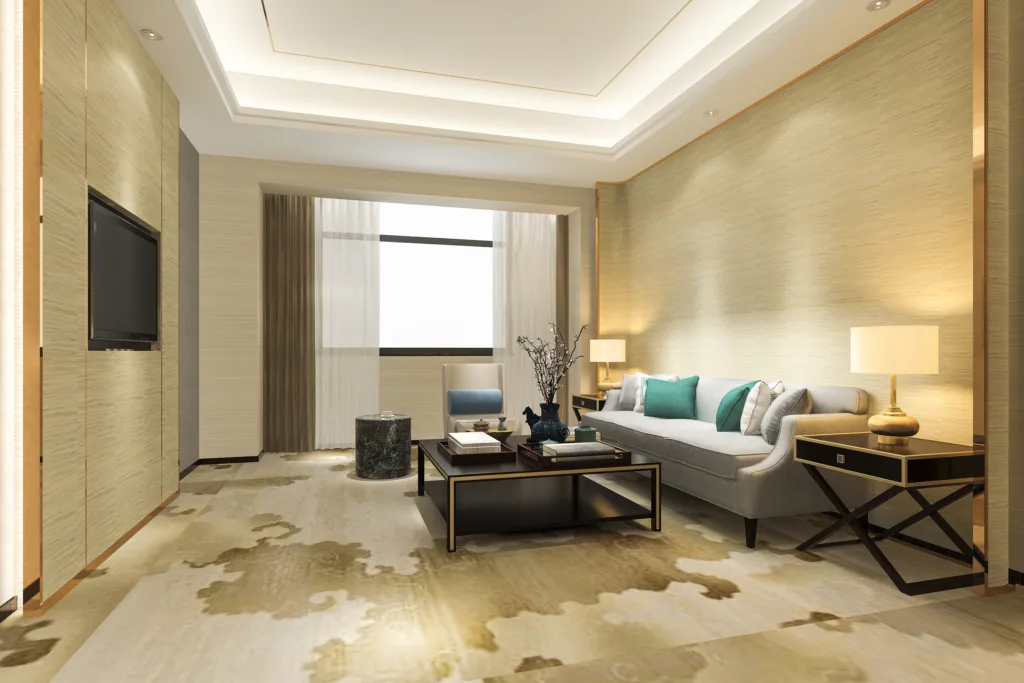
A false ceiling that drops a section of the ceiling to create a lower, more intimate zone above the seating area is one of the more ambitious ceiling treatments available but also one of the most transformative. By reducing the ceiling height over the living area specifically, it creates the sense of enclosure and comfort associated with rooms that feel genuinely cocooning, and it provides the ideal location for recessed lighting, cove lighting, or pendant fixtures that would be disproportionately high in a full-height room.
For rooms in period or rustic properties, the ceiling is often already doing interesting work that has been concealed or ignored. A wooden ceiling treated with a warm oil or left in its natural aged state adds material warmth from above that radiates downward through the whole room. The exposed beam ceiling that reveals original timber structure, whether genuinely old or sympathetically replicated, creates the specific warmth and sense of craftsmanship that is almost impossible to achieve through any other means.
RELATED: 15+ exposed beam ideas for a rustic ceiling
Curtains: Height, Width, and Material
Curtains are one of the most mishandled elements in living room design, and the mistakes are almost always the same: hung too low, too narrow, in a fabric that is too thin, on a rail that ends just beyond the frame rather than well past it. These are the habits that make windows look small and rooms look unfinished, and they are corrected without changing the curtains themselves, simply by rehinging them.
The most transformative curtain decision has nothing to do with the curtain and everything to do with where the rail goes. A rail fixed just above the window frame produces curtains that frame the glass. A rail fixed at ceiling height, or within a few centimetres of the ceiling, produces curtains that extend the window visually to the full height of the room. The same curtain in the second position makes the room feel dramatically taller and more considered. The curtain itself has not changed at all.
Width follows the same principle. A rail that extends to just past the window frame keeps the curtains visible at the sides of the glass when open. A rail that extends generously beyond the frame, so the curtains clear the glass completely when open, makes the window look wider and lets significantly more light into the room. These are positioning decisions that require nothing more than moving the rail brackets.
The curtain ideas that complete a living room’s look cover the full range of fabric, weight, heading style, and colour choice, and the curtain options for framing windows well address the specific decisions about fullness, lining, and length that produce the most polished results. For rooms where a more structured top treatment is appropriate, valance ideas cover the range of cornice boxes, swag valances, and simple flat pelmet treatments that create a finished top to the window arrangement.
Don't miss: 17+ Artistic Wall Decal Ideas for Living Rooms →
Window Treatments for Light and Privacy
The window treatment decision in a living room is ultimately about managing two competing needs: the desire for natural light and the need for privacy or shade. The solution that best serves both simultaneously is usually a layered one, a sheer or translucent treatment that diffuses light while maintaining privacy, combined with a heavier curtain or blind that can be closed when full privacy or blackout is needed.
Sheer linen or cotton panels, hung floor to ceiling on the same rail as heavier curtains, allow the room to be fully lit by diffused natural light throughout the day while maintaining privacy from the street. In the evenings or on very bright days, the outer curtain closes to provide the opacity needed. This two-layer approach provides complete flexibility and creates a visually generous window treatment that reads as sophisticated rather than simply practical.
The window treatment ideas for light and privacy cover the full spectrum of approaches from simple sheers to Roman blinds, plantation shutters, and the various combinations that serve different room orientations and privacy requirements. North-facing rooms that need to retain as much natural light as possible benefit most from treatments that can be fully drawn back to expose the maximum glass area. South-facing rooms that get strong direct light need more substantial shade options that prevent glare on screens and discomfort for people seated in direct sun.
Keep Exploring



Natural Light and Room Orientation
The orientation of a living room, the direction its windows face, determines the quality, intensity, and temperature of its natural light throughout the day, and understanding this is essential for making the right decisions about both window treatments and artificial lighting.
South-facing rooms receive the most light and the warmest light, particularly in the afternoon. They are the easiest rooms to light well naturally but the most likely to suffer from glare and overheating in summer, which means the window treatment needs to manage strong light as well as providing privacy. East-facing rooms get the best morning light but are darker from midday onward. West-facing rooms get the most beautiful late afternoon and evening light but are dark in the mornings. North-facing rooms receive the most consistent but least intense light throughout the day, with no direct sun, which means they need the warmest artificial lighting to compensate for the absence of the warmth that direct sun provides.
Understanding your room’s orientation changes every lighting decision that follows. The artificial light temperature, the choice of paint colour, the weight of the window treatment, and even the placement of mirror to reflect available light are all decisions that should be made in response to what the room’s orientation actually provides rather than in spite of it.
Frequently Asked Questions
How many light sources does a living room need?
As a minimum, three: an overhead source for general ambient light, at least one floor lamp for lower level warmth, and at least one table lamp for a secondary warm source at a different height. More sources create more depth and more flexibility. The overhead fitting should always be on a dimmer so it can be reduced in the evenings when the lower-level sources are doing most of the atmospheric work.
What height should I hang curtains in a living room?
As close to the ceiling as possible, or at ceiling height if the ceiling is standard height. This makes the room feel taller and the windows look larger regardless of the curtain fabric or style chosen. The curtain rail should extend beyond the window frame on each side so the curtains clear the glass entirely when open, allowing maximum light into the room.
How do I make a dark living room feel brighter?
Start with the window treatment: ensure the curtains clear the glass fully when open and are not blocking any light around the edges of the frame. Add a large mirror opposite the main window to reflect available light back into the room. Use warm-toned artificial light from multiple sources rather than a single overhead fitting. Choose lighter tones for walls and large furniture surfaces. All of these cost less than structural intervention and collectively produce a significant improvement.
What is the difference between ambient, task, and accent lighting?
Ambient light fills the room with general illumination, usually from an overhead source. Task light serves specific activities like reading, usually from a directed lamp. Accent light highlights objects, architecture, or surfaces for atmospheric effect, usually from a lower-level or directed source. A well-lit living room uses all three, and the quality that distinguishes professionally designed lighting from domestic defaults is almost always the addition of accent light, which most homes lack entirely.
Should living room curtains touch the floor?
For a finished, considered look, yes. Curtains that stop above the floor look truncated, as if they were cut too short. Floor-length curtains, where the fabric just grazes the floor, look clean and intentional. A slight break, where one to three centimetres of fabric rests on the floor, looks deliberately luxurious. The only exception is in rooms where the floor surface makes long curtains impractical, such as rooms with underfloor heating vents at the base of the wall.
Explore all living room guides in our Living Room section.