How to Decorate an Entryway or Hallway That Sets the Right Tone
A complete guide to creating an entryway and hallway that makes a strong first impression, works hard for the home, and feels as considered as any other room.
KEY POINTS
- The entryway is the first thing anyone sees when they walk into your home and the last thing you see before you leave. It deserves more thought than it usually gets.
- Storage, lighting, and a mirror are the three elements that do the most practical and visual work in any entry or hallway.
- A narrow or small entryway is not a limitation. It is a design problem with clear, well-tested solutions.
The entryway is one of those spaces that most people treat as an afterthought. The real decorating happens in the living room, the kitchen, the bedroom. The hallway is just the bit in between. That thinking produces homes where the first experience a visitor has, and the first experience you have every time you come home, is a space that feels unfinished, cluttered, or simply ignored.
Love Chic Living Club?
Add us as one of your preferred Google sources and discover more home decor, DIY, outdoor, and lifestyle inspiration from us.
Getting the entryway right matters disproportionately to its size. Because it is the first space experienced, it shapes how every room beyond it is perceived. A well-considered entry primes every visitor to see the rest of the home generously. A neglected one does the opposite. This guide covers everything involved in making an entryway and hallway genuinely work, from the essential elements to the details that elevate a transitional space into one that feels intentionally designed.
RELATED: 15+ Entryway Ideas to Create a Welcoming First Impression
Understand What the Space Needs to Do
Before any decorating decision, be clear about what your entryway and hallway actually need to accomplish. These spaces have a functional load that most rooms do not: they receive and shed outdoor clothing and shoes, they transition between the exterior and the interior of the home, and they set an atmospheric expectation for everything beyond them. A beautiful entryway that has nowhere to put a coat is not a well-designed entryway. It is a well-photographed one.
The most successful entries balance three things: storage for the everyday items that pass through them, a visual impression that reflects the character of the home, and enough clear floor space to move through comfortably without feeling squeezed. When any of these three things is missing, the space feels either cluttered, cold, or awkward, and no amount of styling will fully compensate.
Understanding which of these is the primary problem in your specific entryway is the right starting point. An entry that has adequate storage but feels dark and unwelcoming has a lighting and colour problem. One that looks attractive but has jackets piled on a chair and shoes scattered across the floor has a storage problem. One that feels fine functionally but somehow makes the whole home feel smaller than it is almost always has a spatial logic problem that a mirror and some considered lighting can solve immediately.

Sort the Storage First
The most common reason an entryway feels chaotic is not that it is too small or too dark or decorated badly. It is that the things which need to live there have nowhere proper to go. Shoes sit on the floor because there is no rack. Coats pile on the banister because there are no hooks. Keys end up in a different place every day because there is no designated spot.
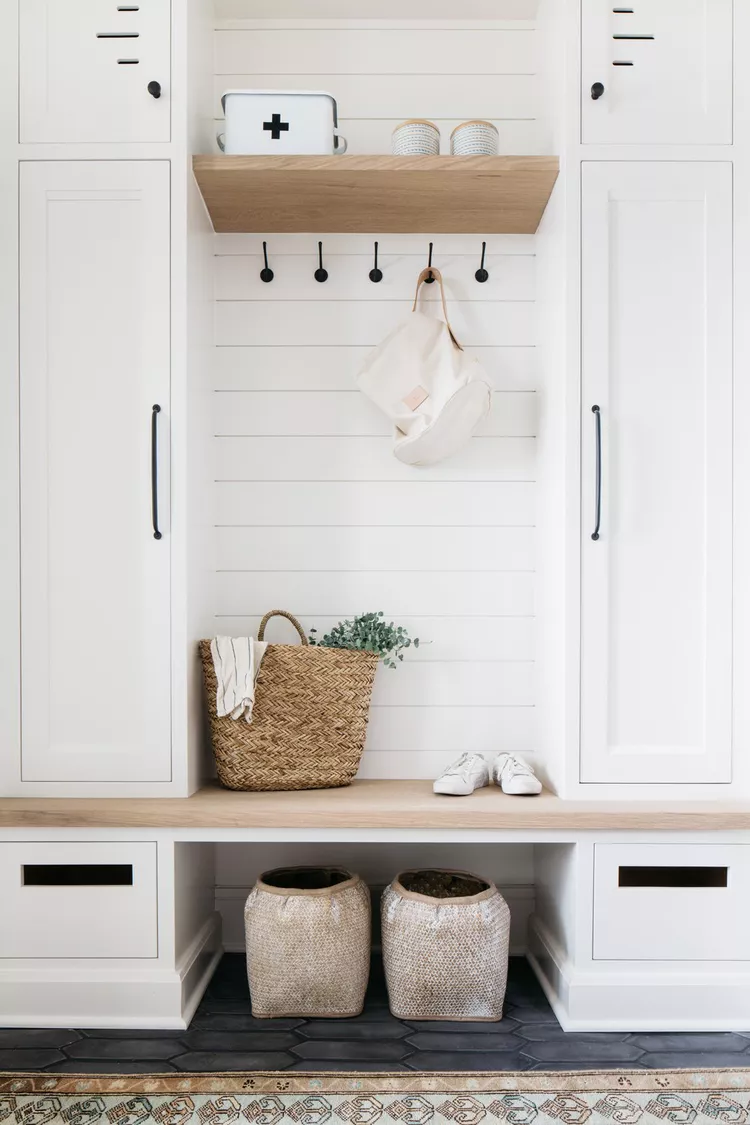
Solving the storage problem before anything else is what allows the entryway to look as good as it can. A coat rack or built-in hooks at the right height for every member of the household gives outerwear a home. A shoe storage solution that is actually used, whether that is a bench with a cabinet beneath it, a slim shoe rack tucked under the console, or a built-in unit beside the door, keeps the floor clear. A small tray or bowl for keys, sunglasses, and the small daily-carry items that would otherwise be scattered across every surface turns a perennial frustration into a non-issue.
The small entryway storage solutions that work best in tight spaces are the ones that go vertical rather than spreading across the floor. A tall, slim cabinet beside the door takes almost no floor area and provides considerably more storage than a console table with a basket beneath it. Dual-purpose entryway tables that incorporate drawers or shelves below the surface solve the storage and the styling problem simultaneously, providing a surface for display while hiding the functional items that need to be accessible but not visible.
RELATED: 17+ Small Entryway Storage Hacks That Look Chic
Add a Mirror
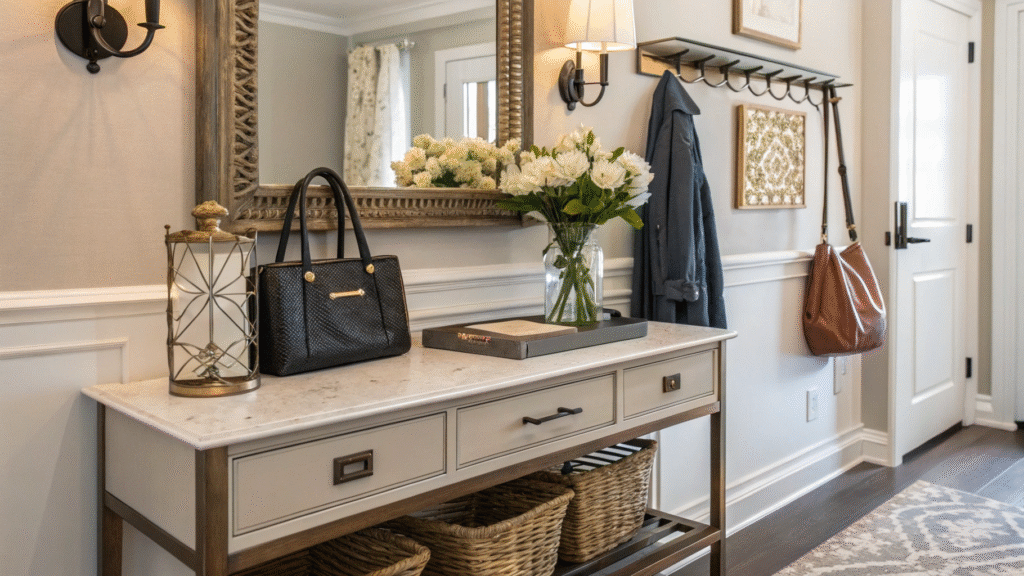
A mirror in the entryway is the single most impactful decorating addition available and the one most consistently underestimated. It does three things at once that almost nothing else achieves: it makes the space feel larger by reflecting the room back into itself, it doubles the light by bouncing whatever natural or artificial light is present, and it provides the practical function of a last-look before leaving the house.
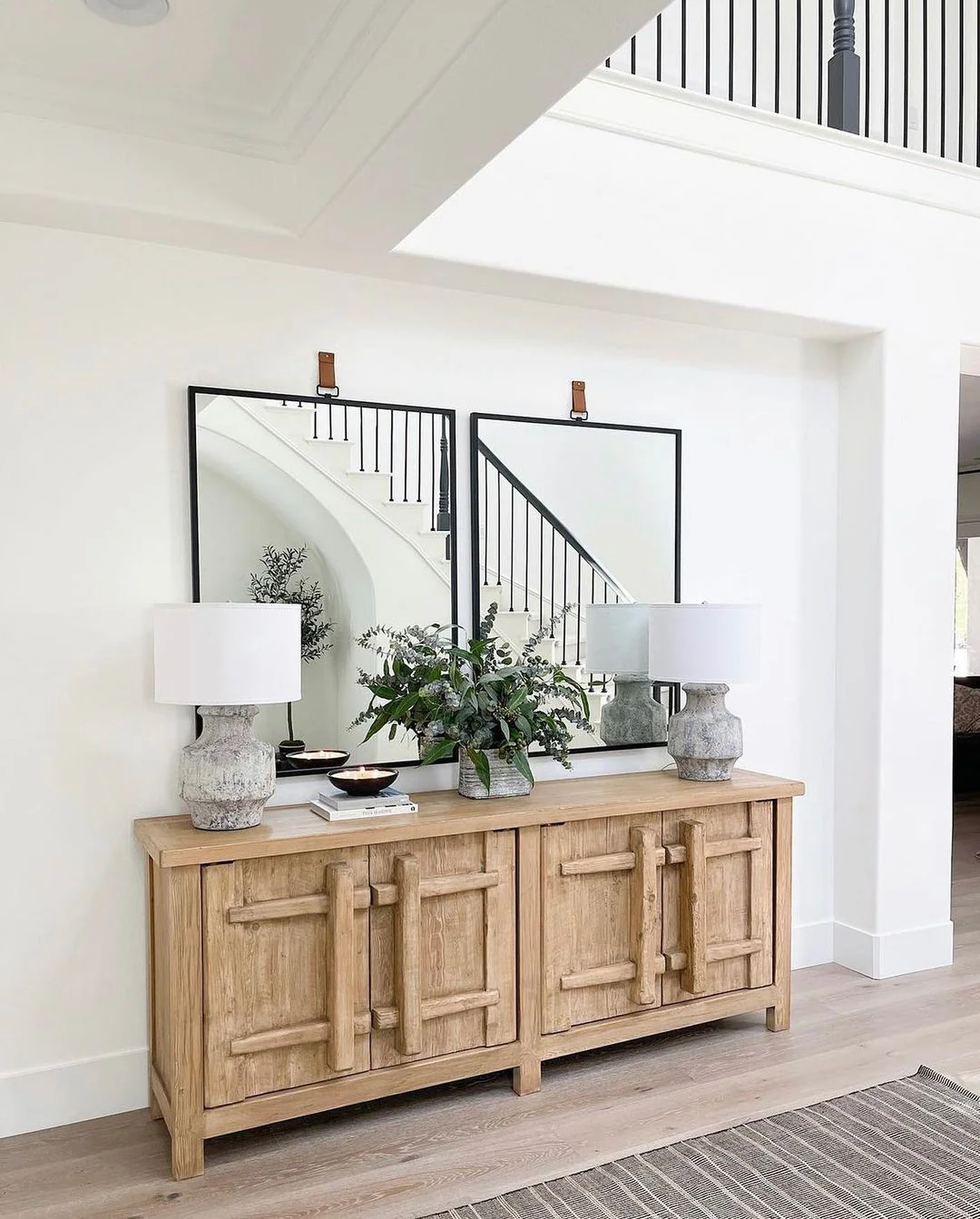
Size matters considerably. A small mirror hung at face height above a console does something. A large mirror, properly scaled to the wall it sits on, transforms the space. The larger the mirror relative to the wall, the more dramatically it amplifies the perceived depth and light of the entryway. In a narrow hallway where floor space is limited, a floor-length mirror leaning against the wall at the far end of the corridor creates a perspective that makes the hallway feel significantly longer and more spacious than it actually is.
The mirror and lighting combinations that work best in entryways use the mirror to amplify a light source placed adjacent to or above it, creating a pool of warm light that feels generous and inviting rather than functional and flat. A sconce mounted on either side of a mirror, or a pendant positioned to reflect in it, produces a quality of light that is disproportionate to the wattage involved.
You May Also Love

Get the Lighting Right
Entryway lighting is one of those elements that is noticed immediately when it is wrong and almost invisibly when it is right. A dark, unwelcoming entry is almost always a lighting failure. A single ceiling fitting in the centre of the space, switched on when dark, produces flat, directionless light that illuminates the space functionally and atmospherically not at all.
The most effective entryway lighting uses a combination of an overhead fitting that provides ambient light and at least one lower-level source, a table lamp on the console, a wall sconce, or lighting that illuminates the floor and the lower half of the space. This layering creates depth and warmth that a single source at ceiling height cannot achieve.
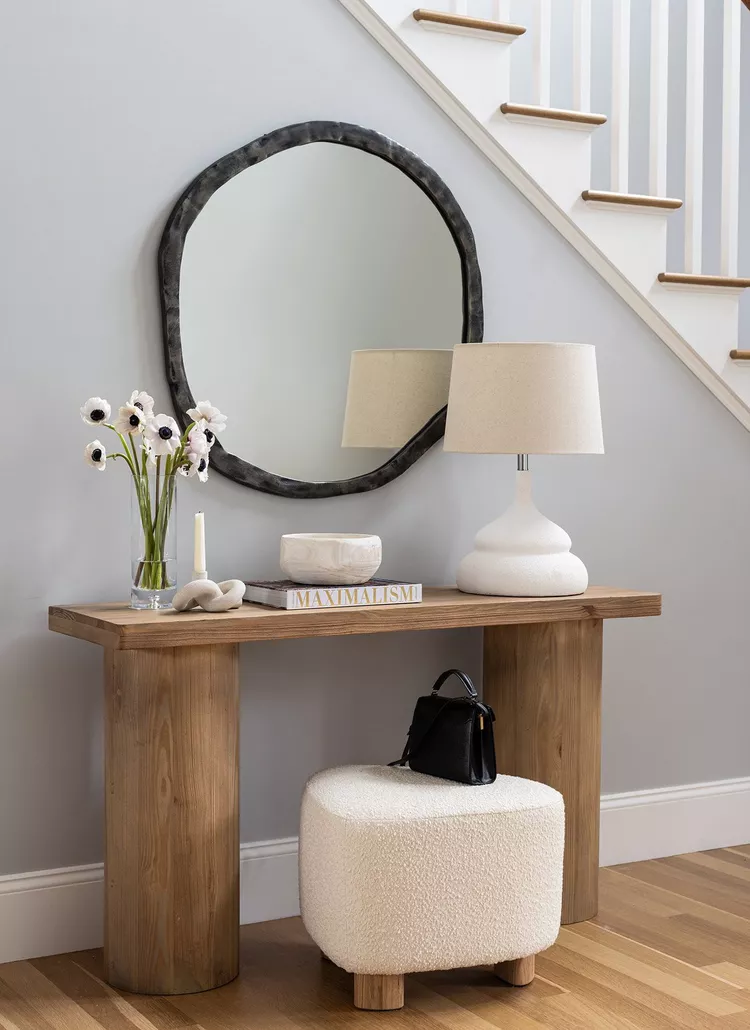
The choice of overhead fitting in an entryway is worth more thought than it typically receives, because the fitting is often one of the most visible elements in the space and one of the few places where a genuinely statement fixture works. A bold entryway lighting choice in the form of an architectural pendant, a sculptural chandelier, or a dramatic wall sconce gives the space a focal point and communicates immediately that the home has been considered with care. It does not need to be expensive to be characterful.
RELATED: 14+ Mirror and Lighting Combos That Brighten Entryways
Choose the Right Console Table
The console table is the piece of furniture most associated with entryway styling and the one most often chosen for appearance without enough thought about how it actually functions in the space. A console that is too deep blocks circulation. One that is too tall feels oppressive in a low-ceilinged entry. One that is too small disappears entirely.
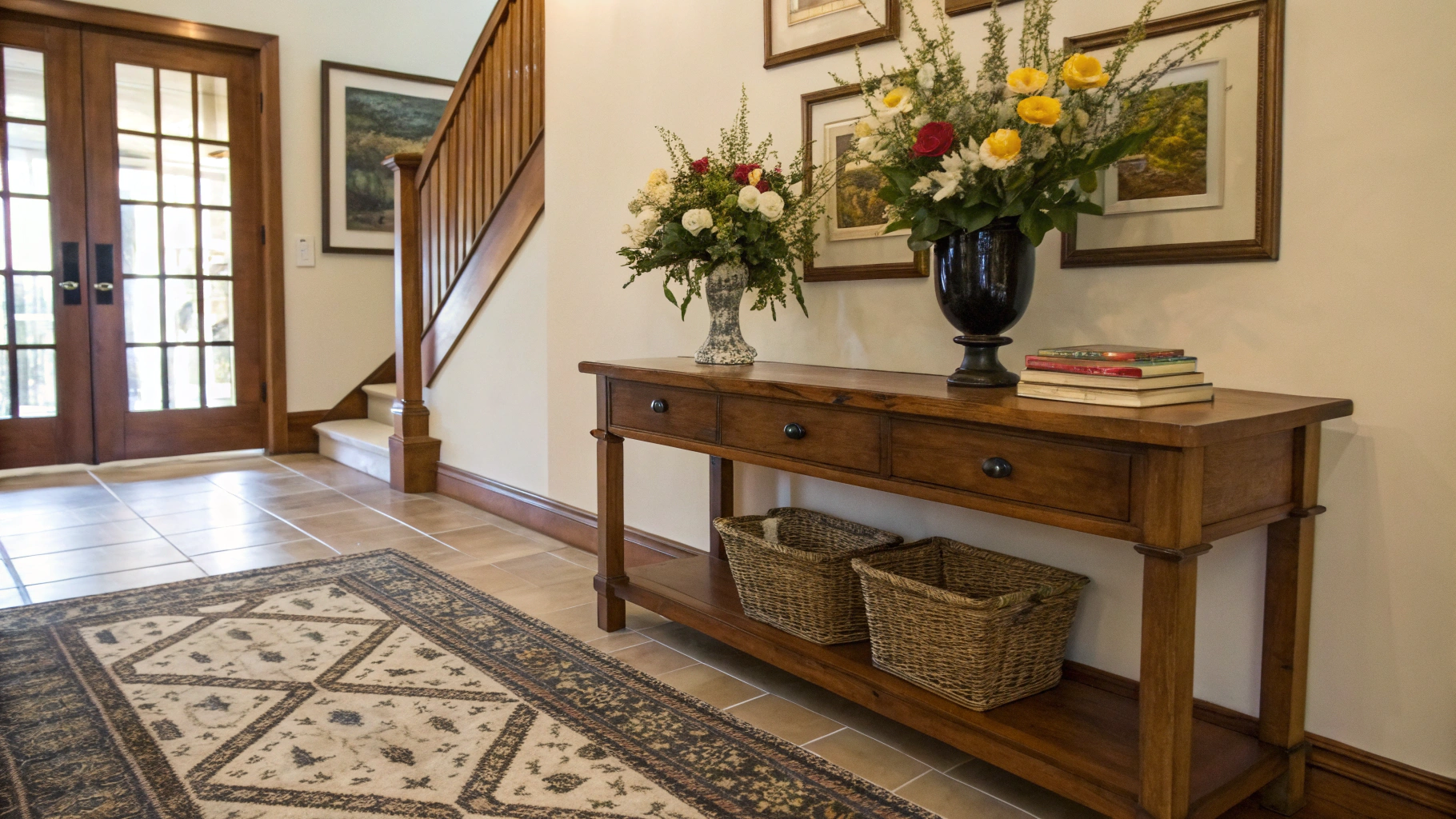
The ideal console table for most entryways is slim, around 25 to 35 centimetres deep, at standard table height or slightly lower, and long enough to make a visual statement without spanning the entire width of the wall. It should leave enough clearance on either side to walk past comfortably without brushing against it. The surface should be large enough to hold a lamp, a few considered objects, and the practical items that need to live there, without those things crowding each other.
Entryway table decor that works well uses the same principles that apply to shelf styling anywhere: vary the heights, keep roughly a third of the surface clear, mix categories between functional and decorative, and let one element be genuinely interesting rather than everything being quietly pleasant. A small plant or a vase of whatever is seasonal, a lamp that casts warm light, a tray for keys, and one thing that has real character is the arrangement that looks considered without looking laboured.
Work on the Walls
Hallway and entryway walls are the longest, most continuously visible surfaces in the space, and they receive less design attention than almost any other surface in the home. Most are painted in the same neutral that was chosen to be inoffensive throughout, which is a reasonable choice and a missed opportunity simultaneously.
The walls of a hallway are seen in passing rather than from a seated, static position, which means pattern and detail read differently here than they do in other rooms. A wallpaper that would feel overwhelming in a bedroom can work brilliantly in a hallway because it is experienced briefly and dynamically rather than from a fixed perspective. Creative entryway wall decor that uses pattern, texture, or a gallery arrangement introduces personality into a space that is easy to treat as merely transitional.
A colour palette chosen specifically for the entryway rather than defaulted from the rest of the house can dramatically change how the entry feels. A deep, confident colour on the entryway walls, even in a small space, creates a sense of welcome and drama that a standard neutral cannot. A warm charcoal, a deep teal, a rich terracotta, these are colours that feel inviting rather than expansive, and in a hallway where the goal is atmosphere rather than perceived size, they often outperform the light neutrals that feel like the safe choice.
Don't miss: 15+ Cozy Entryway Rug Ideas to Welcome Guests Warmly →
Add a Bench or a Seat
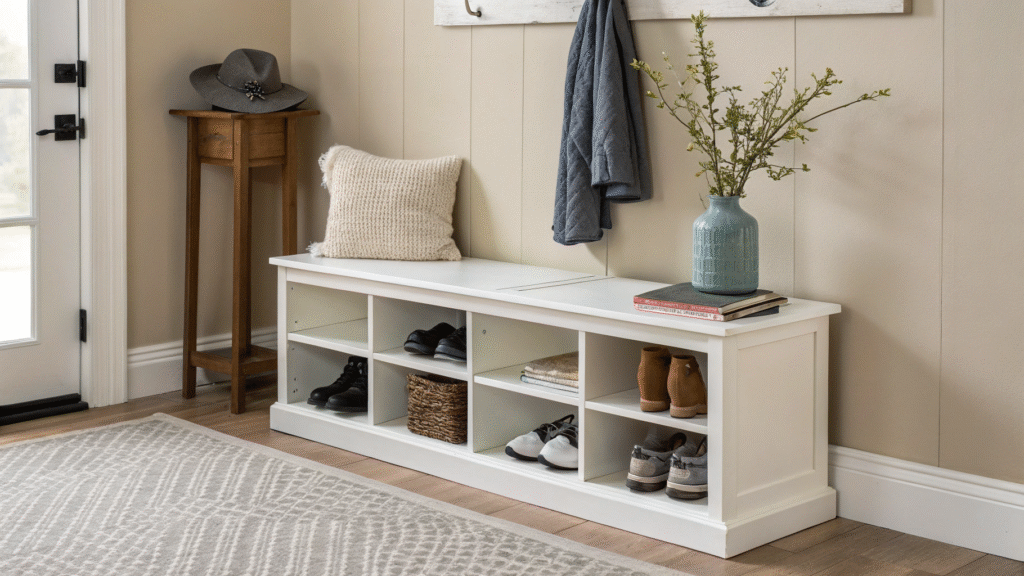
An entryway bench serves two purposes that are both more important than they might seem at first. Practically, it gives you somewhere to sit when putting on or removing shoes, which is something that sounds minor until you do it standing up in a cramped hallway every day for a year. Visually, it anchors the lower half of the entryway in a way that a console table alone does not, giving the space a sense of being furnished rather than merely equipped.
A minimalist entryway bench with clean lines and storage beneath it is the most space-efficient option for a tight entry. A longer upholstered bench in a hallway with more room to accommodate it adds softness and warmth that hard-edged furniture does not. In both cases, placing a bench below a row of hooks and above a shoe rack creates a complete entry organisation system within a contained footprint that addresses the three things most likely to create disorder: coats, shoes, and the need to sit while managing them.
Make the Hallway Work
The hallway connecting the entryway to the rest of the home is often the most neglected space in the house. It is treated as circulation rather than as a room, which means it rarely receives the lighting, the wall treatment, or the carefully chosen details that would make it feel like something rather than the space between things.
The primary design challenge of a hallway is that it is long and narrow, which means the usual spatial toolkit of rugs, furniture arrangements, and multiple light sources applies differently. A runner rug along the length of the hallway defines the floor, adds warmth underfoot, and introduces colour or pattern in a way that is easily changed. Wall art or mirrors hung along the hallway at intervals create a sense of destination and progression rather than a long, unbroken corridor.
The hallway ideas that transform a basic corridor into something genuinely beautiful almost always involve treating the ceiling with as much attention as the walls, using the full height of the space for storage or display where applicable, and making sure the lighting at the far end of the hallway draws the eye rather than allowing the corridor to fade into dimness.
Keep Exploring

TIP: Paint the far end wall of a long hallway in a slightly deeper or warmer tone than the side walls. This creates a visual destination that draws the eye forward and makes the hallway feel intentionally designed rather than arbitrarily extended. It costs nothing beyond a small amount of paint and changes the spatial experience of the corridor more effectively than almost any furniture addition.
Style It With a Clear Aesthetic
The entryway and hallway are the spaces where committing to a clear aesthetic pays the most dividends, because these are narrow, contained spaces where coherence is immediately apparent and inconsistency is immediately jarring. The rooms that look most considered in photographs almost always have a consistent thread running through them, in the colour, the materials, and the objects chosen.
A Scandinavian entryway uses clean lines, natural materials, a calm neutral palette, and carefully considered storage to create a first impression of order and warmth. Nothing is superfluous. The hooks are beautiful, the bench is simple, the light is warm, and the whole space communicates that this is a home where things are chosen with care.
A modern entryway applies the same restraint with a slightly more architectural sensibility: a statement pendant, a slim console in a bold material, a large mirror in a considered frame, and a floor tile with enough presence to anchor the whole space. The natural texture entryway designs that bring materials like jute, raw linen, stone, and unfinished wood into the entry create a quality of warmth and organic presence that polished, hard-surfaced spaces rarely achieve.
For those interested in sustainable entryway design, the material choices in an entry, the flooring, the furniture, the hooks and hardware, present a focused and manageable opportunity to choose better. Reclaimed timber, natural fibre rugs, locally made ceramics, and furniture that will last rather than being replaced, all make a difference that is visible in the quality of the space as well as the sustainability of the decisions behind it.
RELATED: 11+ Modern Entryway Styling Ideas for 2026 Homes
Add the Finishing Details
Once the structure of the entryway is right, the finishing details are what give it its personality. These are the elements that cost least and contribute most to the sense that the space has been genuinely thought about.
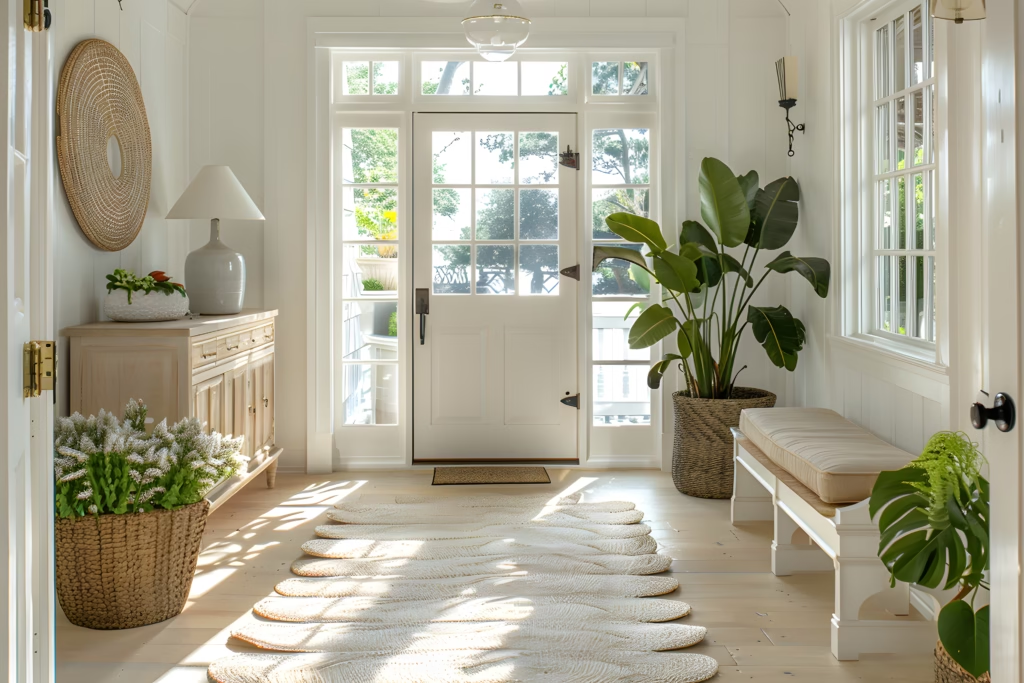
A rug in the entryway is both practical and visual. It protects the floor, defines the entry zone, and introduces colour and texture in a way that is easily refreshed when tastes change. Entryway rug choices should be durable enough to handle the foot traffic of an entry, which is the highest-traffic floor area in most homes, and interesting enough to contribute to the first impression rather than merely protecting the floor beneath them.
Plants in the entryway, even a single well-chosen specimen in a beautiful pot, add a quality of life and welcome that no object can replicate. The entry plant needs to be suited to the actual conditions: most hallways have lower light than other rooms and may have temperature fluctuations from the exterior door. Cast iron plants, snake plants, and ZZ plants are all tolerant of these conditions and look confident and deliberate when chosen at the right scale.
For those who want to integrate technology into the entryway in a way that improves daily function without compromising the aesthetic, smart entryway gadgets including video doorbells, smart locks, and motion-activated lighting can be integrated into a well-styled entry in ways that are almost invisible when the devices are chosen carefully and positioned thoughtfully.
Frequently Asked Questions
How do I make a small entryway look bigger?
Use a large mirror on the primary wall to reflect light and depth back into the space. Keep the floor as clear as possible by using vertical storage rather than floor-standing pieces. Choose a light, warm colour for the walls rather than a dark or cool one. A slim console table rather than a deeper piece of furniture maintains surface space without encroaching on the circulation route.
What are the most important things to have in an entryway?
In order of practical importance: somewhere to hang coats, somewhere to put shoes, a mirror, and a surface for the small daily-carry items that would otherwise be scattered. A lamp or considered lighting makes everything above look intentional. These five elements together are what make an entryway functional, and a functional entryway is the precondition for a stylish one.
How do I style a console table in an entryway?
Keep the surface mostly clear. A lamp on one side, a mirror or piece of art above, a small plant or vase, a tray for keys, and one object you find genuinely interesting is the arrangement that looks considered without looking laboured. The instinct to fill the surface completely is the one most worth resisting.
What colour should I paint my entryway?
The colour that serves the entryway best depends on its size and light. In a small, dark entry, a warm mid-tone rather than a very dark or very cool colour works best. In a larger, well-lit entry, you have considerably more latitude, and a deeper, more confident colour often reads better than a neutral, because the entry is experienced briefly and a bold colour creates drama and personality without the fatigue that the same colour might produce in a room you spend hours in.
How do I make a long narrow hallway feel less like a corridor?
Break the length visually by hanging art or mirrors at intervals rather than leaving the side walls bare. Use a runner rug to warm and define the floor without interrupting the visual length. Make sure the far end of the hallway has something worth looking at, a piece of art, a window, a plant. And consider painting the end wall in a slightly warmer or deeper tone to create a visual destination that draws the eye rather than allowing the corridor to fade into the distance.
Explore more room-by-room guides in our complete Rooms section.