How to Decorate a Dining Room That Makes Every Meal Feel Special
A complete guide to creating a dining room that works beautifully for everyday meals, dinner parties, and every occasion in between, from the table and lighting to colour, style, and the finishing details.
KEY POINTS
- The dining room is the one room in the home built around gathering. Every design decision should serve that purpose, making the space warm, comfortable, and generous enough that people want to linger.
- Lighting is the single most impactful element in a dining room. A pendant positioned correctly above the table changes the entire atmosphere of every meal.
- A dining room that feels considered does not need to be expensive or formal. It needs a clear point of view, good light, and a table worth sitting around.
A dining room carries a specific kind of pressure that other rooms do not. It is the setting for celebrations, for family dinners, for the conversations that happen after the food is finished and nobody wants to leave. It is also the setting for Tuesday night pasta and homework spread across the table. Getting a dining room right means designing a space that works for both: warm and atmospheric enough for the occasions worth marking, relaxed and functional enough for the everyday.
Love Chic Living Club?
Add us as one of your preferred Google sources and discover more home decor, DIY, outdoor, and lifestyle inspiration from us.
Most dining rooms fall short of this because they are designed with only one of those purposes in mind. A room that feels too formal for casual use gets avoided. A room that is purely functional never creates the atmosphere that makes a meal feel like an occasion. This guide covers every element involved in getting the balance right.
RELATED: 15+ Dining Room Decor Ideas That Instantly Elevate the Space
Start With the Table
The dining table is the most important piece of furniture in the room and the one every other decision orbits around. Its size determines how many people you can seat and how much space remains for movement. Its shape changes the dynamics of conversation. Its material sets the visual and tactile tone for the whole room.
Size should be determined by how many people you actually feed regularly, not by the maximum you might occasionally need to accommodate. A table sized for eight that is regularly used by four will always feel oversized and slightly depressing for everyday meals. A table sized for four to six, with the option to extend for larger gatherings, tends to be the most liveable choice for most households.
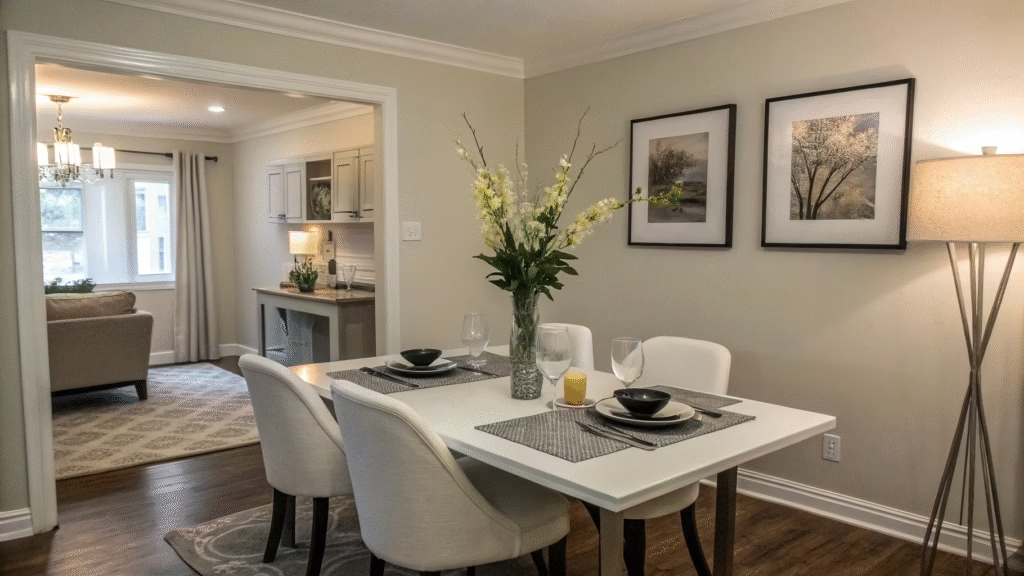
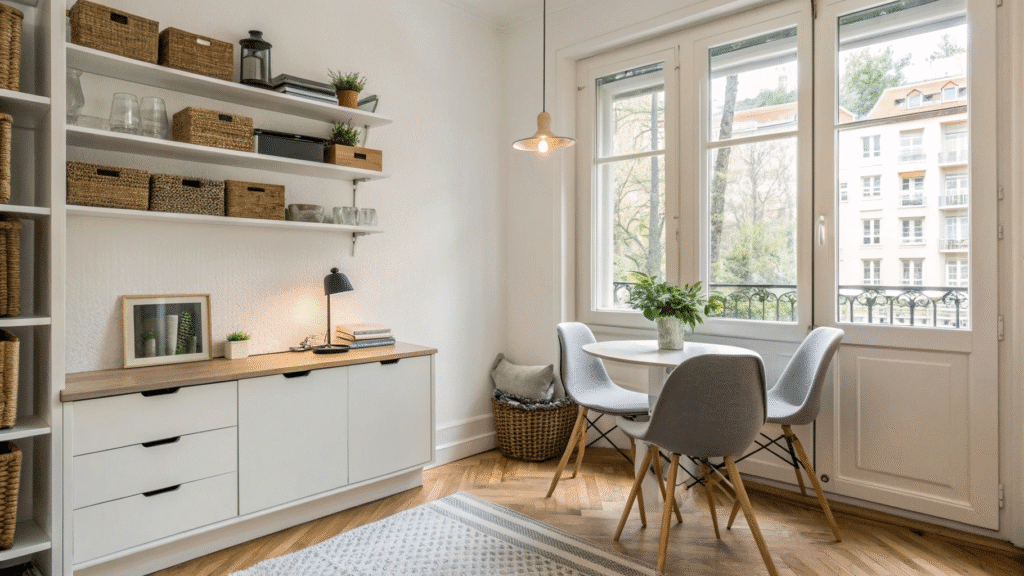
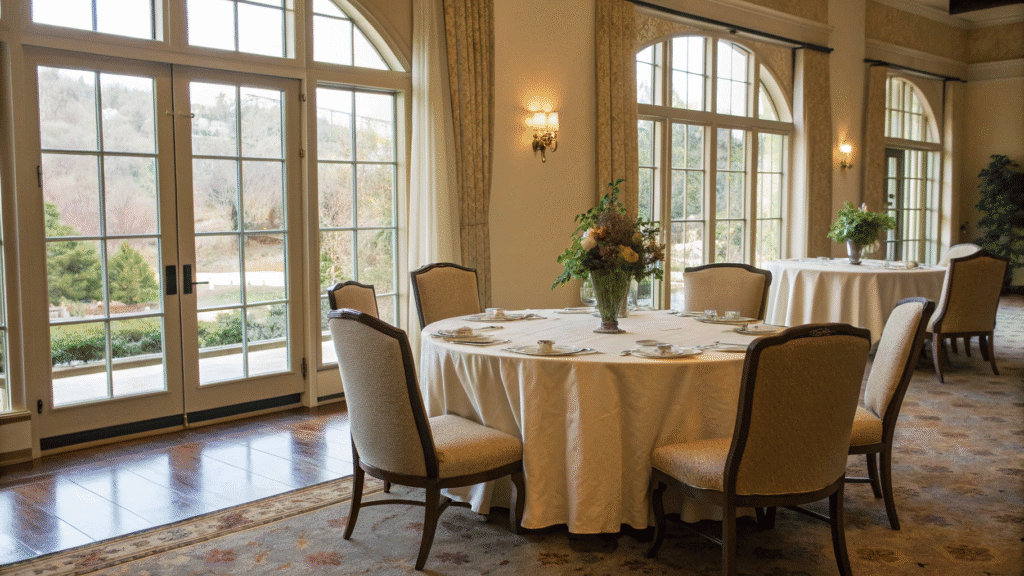
Shape is a more personal decision than most guides suggest. A rectangular table suits a longer room and naturally creates a sense of head and foot that works well for formal gatherings. A round dining table changes the social dynamic entirely: everyone faces everyone else, conversation flows more easily, and the table feels more democratic and more intimate. For a room where conversation and connection matter as much as the meal itself, a round or oval table is often the better choice regardless of the room’s proportions. A small round table in a compact dining space creates a cosy, conversation-first atmosphere that a small rectangular table rarely achieves.
Material tells the story of the room’s character more than any other single element. A solid oak table in a warm honey tone reads as timeless and inviting. A black dining table in a room with contrasting light walls and warm brass lighting reads as contemporary and confident. A marble or stone surface reads as luxurious and slightly formal. Whatever material you choose, it sets the visual register for every other decision that follows.
Choose Chairs That Are Actually Comfortable
The chairs around a dining table determine whether a meal ends at the plate or continues long into the evening over wine and conversation. Uncomfortable chairs send people to the sofa the moment the food is finished. Chairs that are properly comfortable, with real back support and enough seat depth, keep people at the table.
This sounds obvious and is consistently overlooked. Most dining chairs are bought primarily for appearance and are tested briefly in a showroom where sitting for thirty seconds tells you very little about sitting for two hours. When evaluating dining chairs, sit in them for at least five minutes before buying. Check that the seat depth suits the height of the people who will be using them, that the back provides actual lumbar support rather than just a vertical surface, and that the height suits the table you are pairing them with.
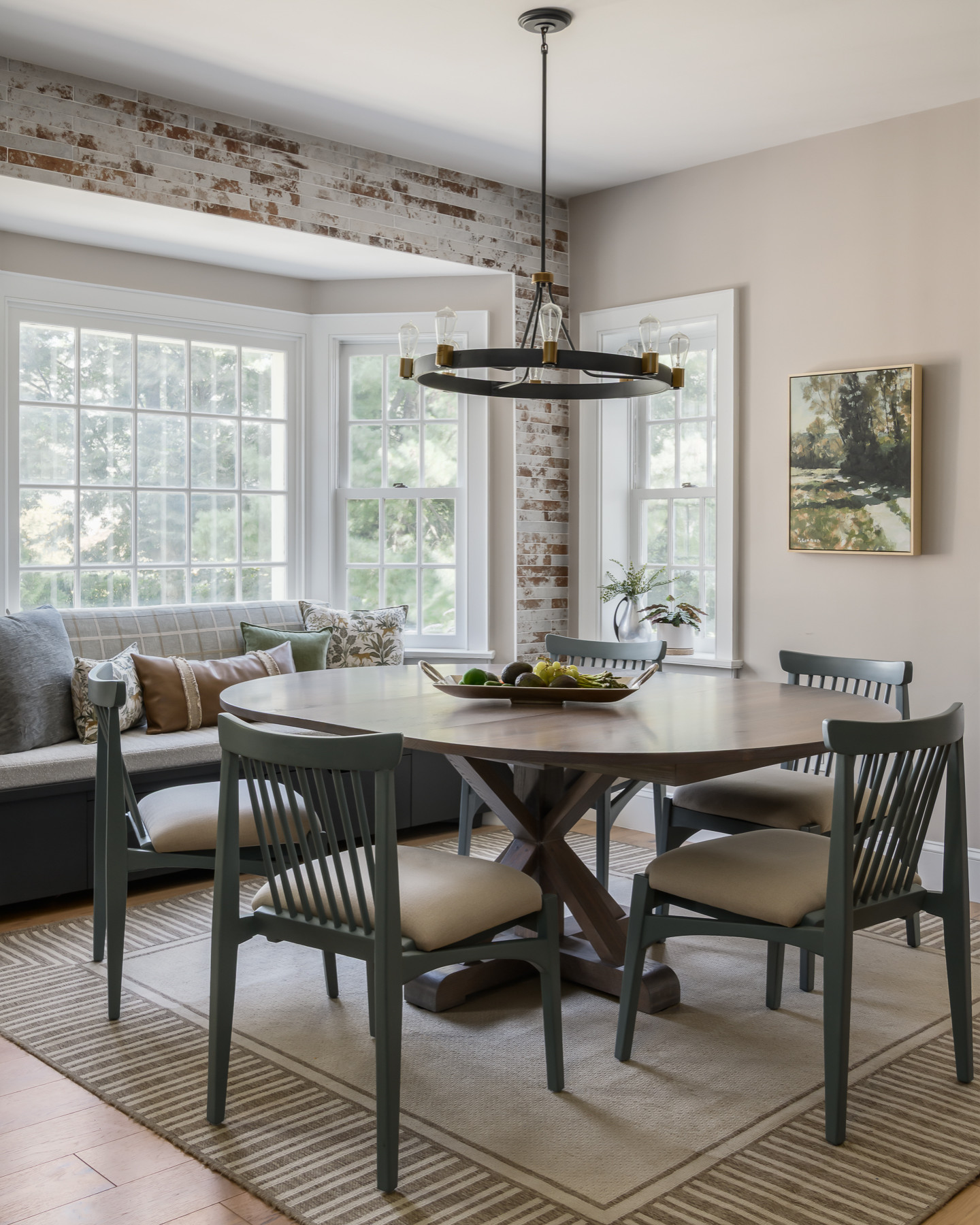
Mixing chair styles around a dining table is one of the design moves most associated with an eclectic, collected aesthetic, and when done well it looks genuinely interesting rather than mismatched. The key is having a unifying element: the same colour, the same material, or at minimum the same seat height. A set of identical chairs on three sides and a bench on the fourth is a practical variation that also looks deliberate. A pair of armchairs or carvers at the head and foot of a long table creates a sense of occasion that matching side chairs alone rarely produce.
Get the Lighting Right
Lighting is the most transformative element in a dining room and the one that receives the least thought at the design stage. The right pendant over a dining table changes the quality of every meal eaten beneath it. The wrong one, whether it is the wrong size, the wrong height, or the wrong quality of light, undermines the atmosphere of the room regardless of how good everything else is.
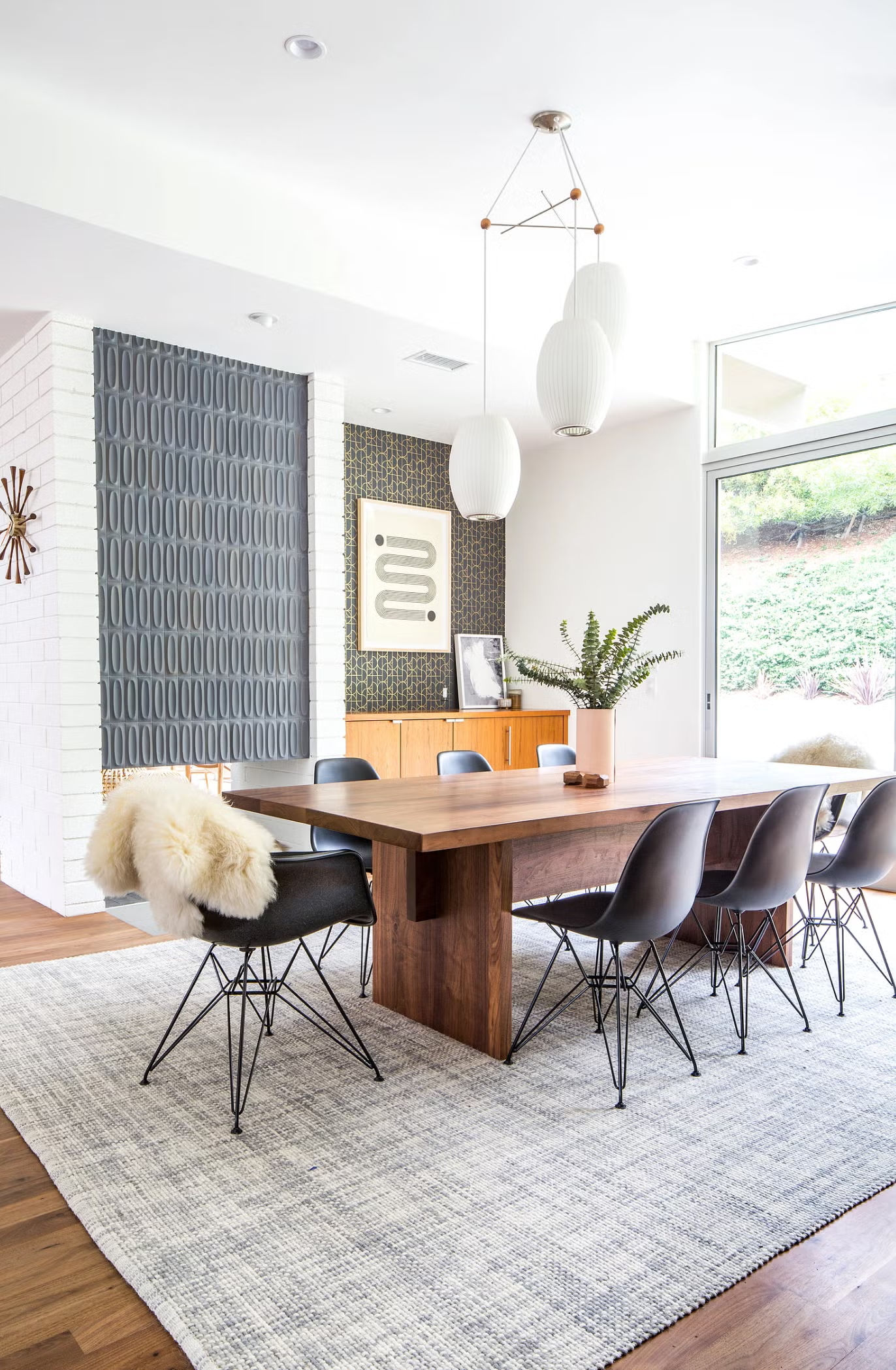
A pendant hung directly above the centre of the table, at the right height, is the starting point. The bottom of the shade should sit roughly 75 to 90 centimetres above the table surface for a standard ceiling height. Too high and the light spreads too broadly and loses its intimacy. Too low and it intrudes on sightlines across the table. Getting this height right before hardwiring anything is worth the effort of testing with a temporary fixture.
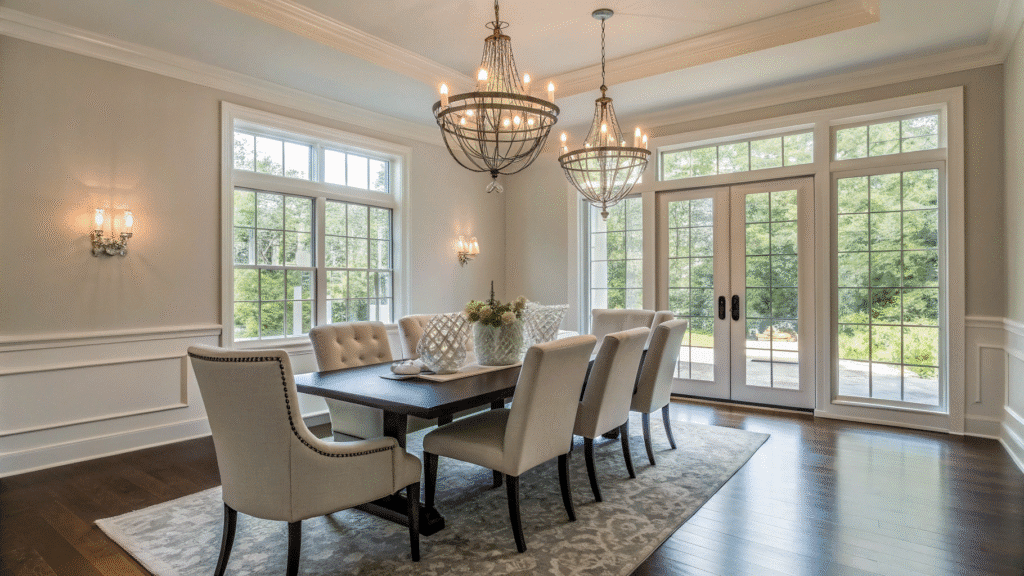
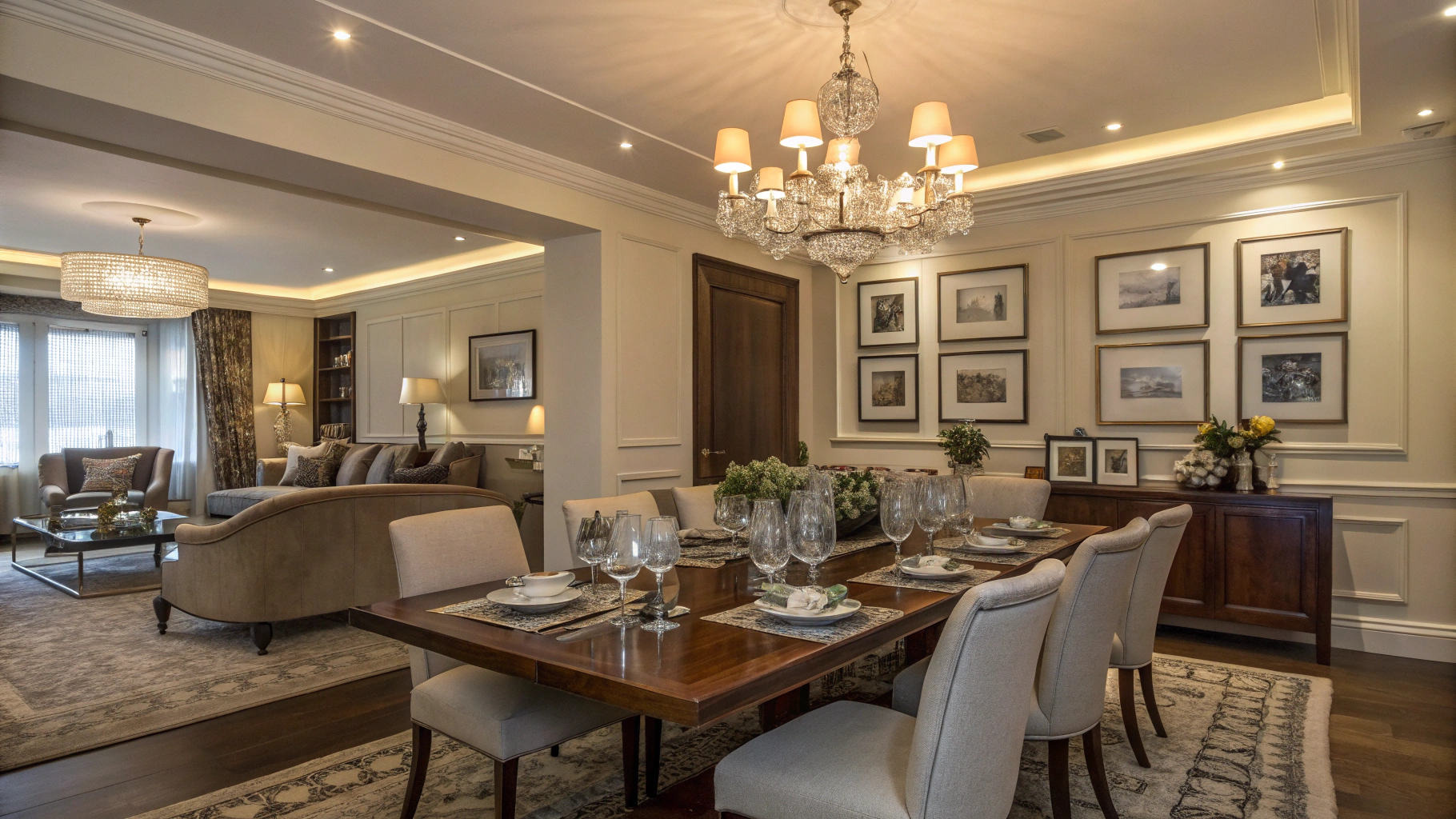
The dining room light fixture carries a considerable amount of visual weight in the room because it occupies the centre of the space at eye level when standing and above eye level when seated. A fixture that has genuine character, whether that is a sculptural rattan pendant, an architectural cluster of bulbs, a classic cloth-shade fixture in a considered size, or a chandelier scaled to the room, becomes a focal point that elevates the whole room. A generic flush fitting or a pendant chosen without regard to the room’s proportions will always make the room feel unfinished.
The quality of light the fixture produces matters as much as its appearance. Warm white bulbs at 2700 Kelvin produce the kind of flattering, golden light that makes food look appetising and people look well. The dining room is one of the few places where a dimmer switch is absolutely essential rather than merely desirable. The ability to take the room from bright and functional for a casual breakfast to soft and atmospheric for a dinner party is the single change that gives a dining room the most versatility.
RELATED: 17+ Dining Room Light Fixture Ideas to Brighten and Impress
Anchor the Room With a Rug
A rug beneath a dining table does two things simultaneously. It defines the dining zone within the larger room, giving the table and chairs a contained visual boundary that makes the arrangement feel intentional rather than placed. And it softens the hard surfaces of a room that tends to be full of them: the table, the chairs, the floor, the walls.
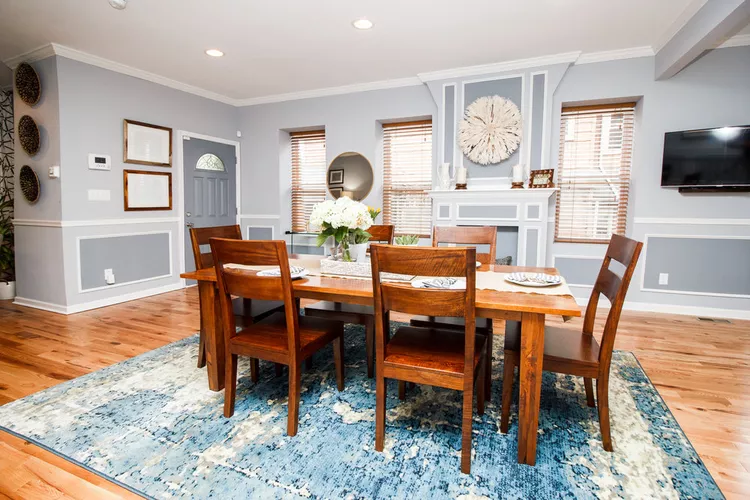
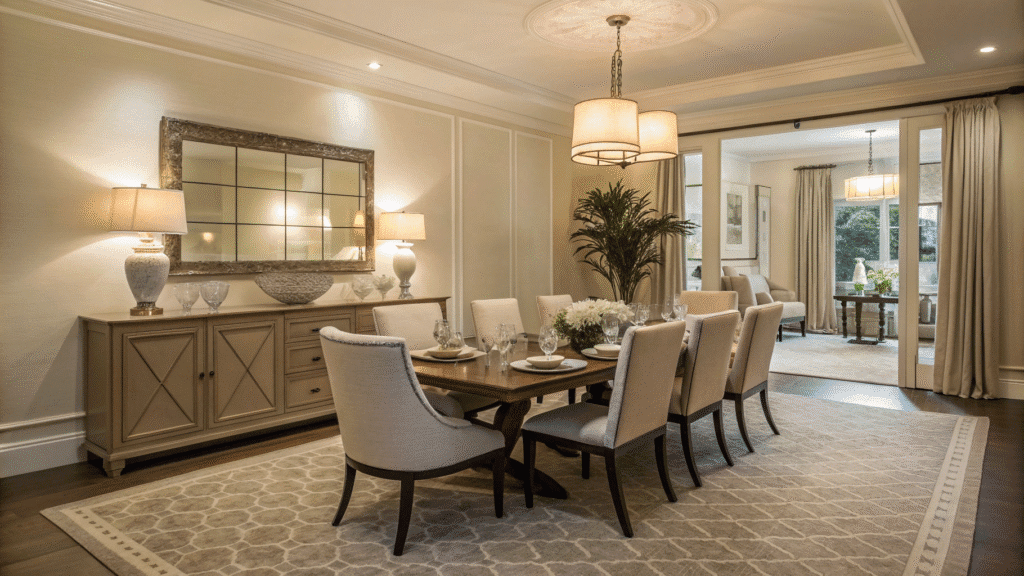
The sizing rule for a dining room rug is non-negotiable: the rug must be large enough that all the chair legs remain on it even when the chairs are pulled back from the table to sit down. A rug sized only to the table legs will reveal this problem at every meal, with chairs dragging off the edge and catching on the border. For most dining tables, this means a rug considerably larger than feels necessary when the table is empty.
Dining room rug choices that work well in high-traffic eating environments tend toward flatweave or low-pile constructions that clean easily. A rug with a pattern has the practical advantage of hiding crumbs and stains that would be immediately visible on a plain surface, and patterned rugs also add visual warmth in a way that a plain rug cannot.
Colour Sets the Mood
The colour of a dining room affects how every meal in it feels, and the dining room is one of the spaces in a home where going deeper and more confident with colour tends to pay the most dividends. Because it is a room used primarily in the evenings, natural light is less of a concern than it is in a bedroom or living room, and deeper, richer colours that might feel overwhelming in a daytime room create exactly the warmth and intimacy that a dining space benefits from.
Dark dining rooms painted in deep charcoals, moody greens, rich navies, or warm terracottas with good warm lighting have a quality of enveloping intimacy that paler palettes struggle to achieve. The rooms that look most atmospheric in dining room photography are almost always the darker ones. The reason most people hesitate is that the same colour looks very different in a daytime photograph than it does in the warm evening light for which the room is actually designed.
For those who want colour without committing the whole room, a single feature wall behind a sideboard or a painted ceiling in a deeper tone introduces drama without the commitment. Bold colour in a dining room works particularly well when it is paired with natural materials in the furniture that ground the space and prevent the colour from feeling theatrical.
White dining rooms at the other end of the spectrum work when they are genuinely warm rather than stark, with warm-toned walls, natural textures in the furniture and textiles, and lighting that prevents the room from feeling clinical. Neutral dining rooms that use a palette of warm taupes, greiges, and soft natural tones create a calm, inclusive atmosphere that makes the food and the company the visual focus rather than the room itself.
RELATED: 21+ Dining Room Paint Color Ideas to Set the Right Mood
Style the Walls
The walls of a dining room offer significant opportunity that most people leave underdeveloped. Beyond paint, there is a range of treatments that can give a dining room the kind of architectural character and visual depth that lifts it from a functional room into something genuinely memorable.
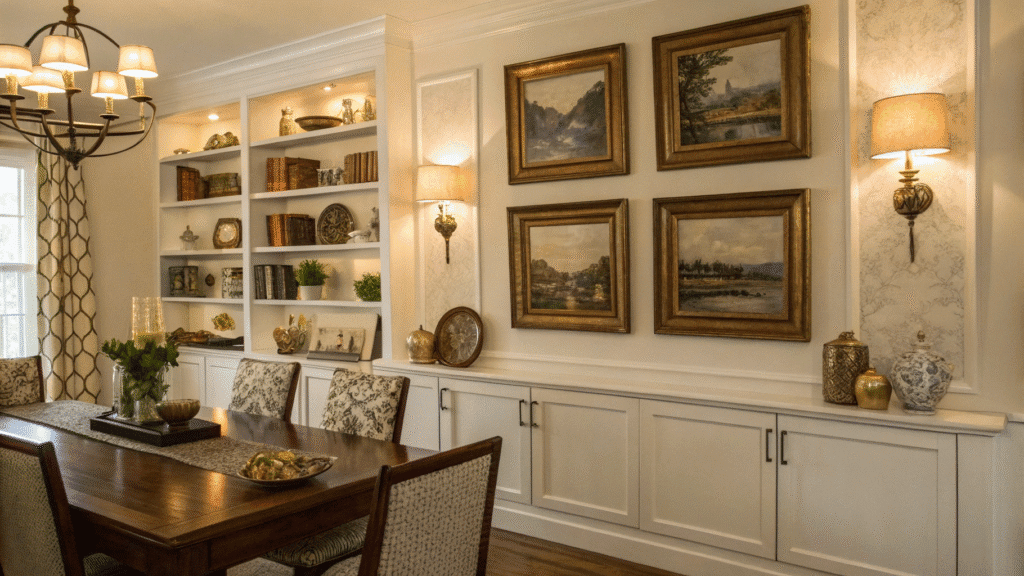
Panelling on the lower half of the walls, with a painted or papered upper section, is one of the most classically effective treatments for a dining room. It adds architectural detail, creates a visual break at the right height for a seated view, and gives the room a quality of permanence that helps a dining space feel important. Dining room wall decor beyond panelling includes a large-scale mirror that reflects the pendant and amplifies the light, a gallery of botanical prints that brings organic warmth, or a single oversized piece of art that makes the room feel curated.
A dining room built-in along one wall, combining display shelving with closed storage, is one of the most practical and most beautiful additions to a dining space. It provides a place for crockery, glasses, and serving pieces that would otherwise live in kitchen cabinets too far from the table, and it gives the room a continuous architectural feature that anchors the whole composition.
Choose a Style and Commit to It
The dining rooms that feel most memorable are almost always the ones with a clear point of view. A room that tries to be all things, a little rustic here, a little modern there, a little eclectic there, without a unifying logic tends to feel like it cannot decide what it wants to be.
A farmhouse dining room commits to honest materials, warm wood tones, a ceramic or stone table surface, simple shaker-style furniture, and a relaxed generosity that makes every meal feel like a kitchen supper. A modern dining room applies restraint in decoration and richness in materials: a sculptural table, chairs with considered profiles, a statement pendant, and very little else. A mid-century modern dining room uses the distinctive silhouettes and warm wood tones of the era with enough contemporary restraint to feel current rather than retro.
A dark, moody dining room takes a confident approach to atmosphere, using deep colour, warm lighting, and rich materials to create a space that is genuinely immersive. A boho dining room brings natural textures, layered textiles, mismatched ceramics, and an abundance of plants and dried botanicals. A coastal dining room uses the breezy palette and natural materials of the sea to create a light, relaxed atmosphere. A glam dining room leans into reflected surfaces, rich fabrics, and the kind of considered excess that makes a meal feel like an event. A Scandinavian dining room achieves warmth through restraint: clean lines, natural materials, calm colours, and the absence of anything superfluous.
RELATED: 16+ Vintage Dining Room Ideas Full of Character and Charm
Style the Table
The way the table is dressed on an ordinary day has as much impact on the feel of the dining room as any decorating decision. A bare table with nothing on it looks utilitarian. A table with a simple centrepiece, even just a plant, a small vase, or a bowl of fruit, communicates that the space is cared for.
Dining room centrepiece ideas that work well for everyday use are ones that do not interrupt sightlines across the table, are easy to move when the table is needed for something else, and are changed often enough to stay interesting. A low bowl of seasonal fruit, a cluster of candles at different heights, a single stem in a beautiful vase, or a trailing plant in a simple pot are all approaches that add life to the table without imposing on it.
For occasions and dinner parties, the table setting is part of the experience. Dining room table decor for a dinner party does not need to be elaborate to be effective. A clean tablecloth or linen runner, matching crockery, candlelight, and a simple centrepiece in a consistent colour family creates an atmosphere of care and intention that guests feel immediately.
TIP: The single most effective improvement to an ordinary weeknight table is candles. Two or three pillar candles or a cluster of tea lights in simple holders, lit ten minutes before sitting down, shift the atmosphere of even the most casual meal. The warm, moving light of candles does something that no fixed light source replicates, and the habit of lighting them regularly transforms the dining room from a functional eating space into a proper place for gathering.
Make It Work for Small Spaces
A small dining room or dining area is not a limitation on hospitality. It is a constraint that rewards clear thinking about what actually matters in a space for eating and gathering, which is almost always less than people assume.
The most common mistake in a small dining room is choosing a table that is too large, which fills the floor with table while leaving no comfortable space to pull out chairs or move around. A table scaled honestly to the space, with the right clearance on all sides for chairs to be used comfortably, will always outperform an oversized table that the room cannot absorb.
Small space dining room ideas that maximise every inch without sacrificing style show how much is achievable in tight footprints. A dining nook in an apartment that uses a built-in bench along one wall with a compact table and two chairs creates a genuinely welcoming eating space in a fraction of the floor area a conventional table arrangement would require. For narrow townhouse dining rooms where the room itself is the constraint, the furniture choices and the lighting position make an enormous difference to whether the room feels elegantly proportioned or merely cramped.
RELATED: 21+ Dining Room Ideas for Small Homes That Make a Big Statement
Add Storage That Works Beautifully
Dining rooms tend to accumulate things they have nowhere proper to store: extra candles, table linen, serving dishes, the overflow of crockery and glassware that does not fit in the kitchen. A dining room without considered storage either becomes a room where things pile up or a room that requires a trip to the kitchen for everything needed at the table.
A sideboard or credenza is the classic dining room storage solution, and it earns its place by providing both practical concealed storage and a display surface that contributes to the room’s styling. The top of a sideboard is one of the most prominent display surfaces in a dining room, visible from the table and often the backdrop for the room’s most considered arrangements: a mirror, a pair of lamps, a plant, and a few carefully chosen objects.
For rooms where a sideboard takes up too much floor space, a dining room built-in fitted to the wall provides the same storage capacity with a considerably smaller footprint and a more architectural result. For rooms without space for either, floating shelves above a console table create surface and storage in a lighter, less imposing configuration.
Frequently Asked Questions
What size table do I need for my dining room?
Allow at least 90 centimetres of clear space on all sides of the table for chairs to be pulled out and for people to move around comfortably. Measure the room first, subtract the clearance on all sides, and that remaining space is the maximum table footprint. Most rooms are served better by a slightly smaller table with proper circulation than a larger one that feels cramped.
What is the best lighting for a dining room?
A pendant positioned directly above the centre of the table, hung so the bottom of the shade sits 75 to 90 centimetres above the table surface, with a dimmer switch to adjust the level between daytime and evening use. Warm white bulbs at 2700 Kelvin produce the most flattering and atmospheric light for a dining space.
How do I make a small dining room feel bigger?
Choose a table scaled to the room rather than the maximum size the room can physically accommodate. Use a mirror on the wall to reflect the pendant and amplify perceived space. Keep the colour palette light and consistent. A round table is more space-efficient than a rectangular one in a square room, because you can seat the same number of people in a smaller footprint.
What colour should I paint a dining room?
The dining room is one of the few spaces where going darker and more confident with colour tends to produce better results than playing it safe. Deep greens, warm charcoals, rich terracottas, and saturated navies all create the intimacy and warmth that make a dining room feel genuinely atmospheric in the evenings when it is most used. Test the colour in the room under evening light rather than daylight before committing.
How do I decorate a dining room on a budget?
Start with the lighting: a new pendant or a dimmer switch costs little and changes the room more than almost any other single purchase. Then address the centrepiece: candles, a plant, and a simple vase replace nothing with something beautiful for a very small outlay. A good tablecloth or runner transforms a bare table. Beyond those three, a coat of paint in a confident colour is the highest-return room change available at any budget.
Explore more room-by-room guides in our complete Rooms section.