How the subway tile pattern calculator works
The pattern you choose changes how much tile you waste. Enter the width and height of the wall, any area to leave out, the size of the tile, the grout joint, the pattern, the number of tiles in a box and the price of a box. The calculator works out how many tiles you need, adds an allowance for cuts that depends on the pattern, and tells you how many boxes to buy and the cost. It also shows how many rows fit and how tall the cut row at the top is. A second tab shows how much wall your boxes will cover, and a third tab compares five patterns on the same wall.
The formula
The area is the width times the height, minus anything you leave out. Each tile takes up its own size plus the joint on two sides, so the calculator divides the area by the area of one tile with its joint. It then adds the allowance for waste: 7% for straight stack, 10% for running bond, 12% for a third offset, 15% for a diagonal running bond and 20% for herringbone. It rounds up, and divides by the tiles in a box to get the boxes.
Waste by pattern
| Pattern | Extra to buy | Notes |
|---|---|---|
| Straight stack | 7% | A grid, with the least waste |
| Running bond | 10% | Brick offset, the classic subway pattern |
| Third offset | 12% | Each row moves by a third of a tile |
| Diagonal running bond | 15% | An angled cut at every edge |
| Herringbone | 20% | The most angled cuts |
Worked examples
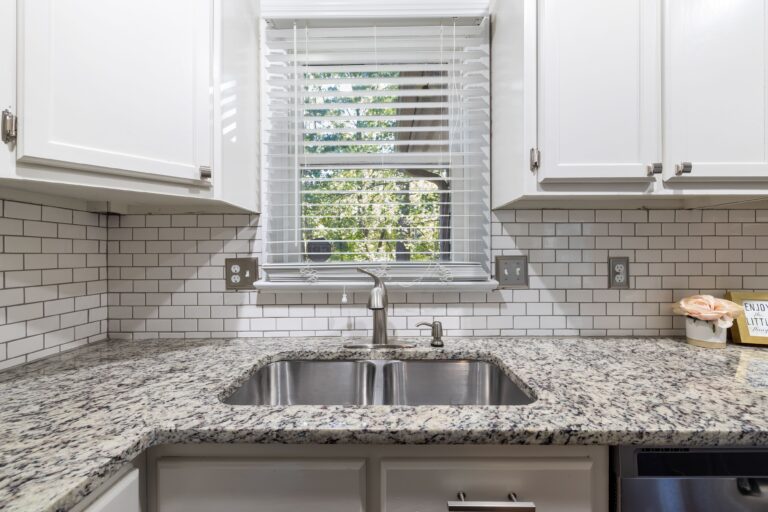
A 10 ft by 4 ft backsplash, 6 in by 3 in tiles in running bond, 1/16 in joint, 44 tiles in a box at $35
The area is 40 sq ft, so you need about 342 tiles with 10% extra, which is 8 boxes, about $280.00. The wall takes 15 full rows and a cut row about 2 in tall at the top. With grout and thinset, you need about 3.6 lb of grout and 1 bag of thinset.
An 8 ft by 8 ft wall with a 15 sq ft window, 12 in by 4 in tiles in herringbone, 1/8 in joint, 11 in a box at $30, with a spare box
The area is 49 sq ft, so you need about 170 tiles with 20% extra. With a spare box that is 17 boxes, about $510.00.
What do 8 boxes of 44 tiles cover?
In running bond, the 352 tiles cover about 45.4 sq ft if nothing is wasted, or about 41.3 sq ft with 10% for cuts.
Comparing patterns on the 10 ft by 4 ft wall at $35 a box
Straight stack, running bond and third offset each need 8 boxes, about $280.00. Herringbone and the diagonal running bond each need 9 boxes, about $315.00.
Common mistakes
- Starting at the counter. Counters and floors are often not level, so start from a level line.
- Ending with a thin cut row. Move the first row, so the cut row at the top is not a sliver.
- Forgetting the joint. The joint adds up across a wall, so the calculator counts it for you.
- Using the same extra for every pattern. Herringbone needs about twice as much extra as a straight stack.
- Not buying a spare box. The same batch may not be sold later, so keep a few tiles for repairs.